Acute bronchitis is swelling and inflammation of the main air passages to the lungs. This swelling narrows the airways, making it harder to breathe and causing other symptoms, such as a cough. Acute means the symptoms have only been present for a short time.
Acute bronchitis almost always follows a cold or flu-like infection. The infection is caused by a virus. At first, it affects your nose, sinuses, and throat. Then it spreads to the airways leading to your lungs.
Sometimes, bacteria also infect the airways. This is called a secondary infection.
Chronic bronchitis is a long-term condition. To be diagnosed with chronic bronchitis, you must have a cough with mucus most days of the month for at least 3 months.
Even after acute bronchitis has cleared, you may have a dry, nagging cough that lingers for 1 to 4 weeks.
At times, it may be hard to know whether you have pneumonia or only bronchitis. If you have pneumonia, you are more likely to have a high fever and chills, feel sicker, or feel short of breath.
Most people DO NOT need antibiotics for acute bronchitis. The infection will almost always go away on its own within 1 week. Take the following steps to get relief:
Drink plenty of fluids.
If you have asthma or another chronic lung condition, use your inhaler (such as albuterol).
Rest.
Take aspirin or acetaminophen (Tylenol) if you have a fever. DO NOT give aspirin to children
Use a humidifier or steam in the bathroom.
Certain medicines that you can buy without a prescription can help break up or loosen mucus. Look for the word "guaifenesin" on the label.
If your symptoms do not improve, your doctor may prescribe an inhaler to open your airways if you are wheezing.
Sometimes, bacteria may also infect the airways along with the virus. If your doctor thinks this has happened, you may be prescribed antibiotics.
Other tips include:
DO NOT smoke.
Avoid secondhand smoke and air pollution.
Wash your hands (and your children's hands) often to avoid spreading viruses and other infections.
You have a cough on most days, or you have a cough that often returns
You are coughing up blood
You have a high fever or shaking chills
You have a low-grade fever for 3 or more days
You have thick, greenish mucus, especially if it has a bad smell
You feel short of breath or have chest pain
You have a chronic illness, like heart or lung disease
What is CPR?
CPR stands for cardiopulmonary resuscitation. This is the lifesaving measure you can take to save someone who shows no signs of life (consciousness or effective breathing).
CPR uses chest compressions and "rescue" breaths to make oxygen-rich blood circulate through the brain and other vital organs until emergency medical personnel arrive. Keeping oxygenated blood circulating helps prevent brain damage – which can occur within a few minutes – and death.
CPR isn't hard to do. Follow these steps:
Step 1: Check the child's condition.
Is the child conscious? Tap on the child's shoulder and call out. If she doesn't respond, have someone call the local emergency number. (If you're alone with the child, give two minutes of care as described below, then call emergency yourself.)
Swiftly but gently place the child on her back on a firm, flat surface.
Make sure she isn't bleeding severely. If she is, take measures to stop the bleeding by applying pressure to the area. Don't administer CPR until the bleeding is under control.
Step 2: Open the child's airway.
Tilt the child's head back with one hand and lift his chin slightly with the other. This will open his airway.
Check for signs of breathing for no more than ten seconds.
To check his breathing, put your head down next to his mouth, looking toward his feet. Look to see whether his chest is rising, and listen for breathing sounds. If he's breathing, you should be able to feel his breath on your cheek.
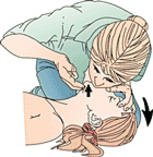
Step 3: Give two "rescue" breaths.
If the child isn't breathing, give her two breaths, each lasting just one second. Pinch the child's nose shut, place your mouth over hers, and exhale into her lungs until you see her chest rise.
If her chest doesn't rise, her airway is blocked. Give her first aid for choking, described above.
If the breaths go in, give the child two rescue breaths in a row, pausing between breaths to let the air flow back out.
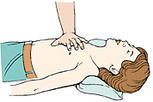
Step 4: Do 30 chest compressions.
Kneel beside the child's upper chest. Place the heel of one of your hands on the child's sternum (breastbone) at the center of her chest. Place your other hand directly on top of the first hand. Try to keep your fingers off her chest by interlacing them or holding them upward.
To do a chest compression, push the child's sternum down about 2 inches. Allow the chest to return to its normal position before starting the next compression.
Do 30 chest compressions at the rate of 100 per minute. Count out loud: "One and two and three and...," pushing down as you say the number and coming up as you say "and." (The song Stayin' Aliveis the right rate!)
When you complete 30 compressions, give the child two rescue breaths (step 3, above). (Each cycle of chest compressions and rescue breaths should take about 24 seconds.)
Step 5: Repeat compressions and breaths.
Repeat the sequence of 30 chest compressions and two breaths. If you're alone with the child, call emergency or the local emergency number after two minutes of care.
Continue the sequence of chest compressions and rescue breaths until help arrives, you find an obvious sign of life, an AED (automated external defibrillator) is ready to use, the scene becomes unsafe, or you are too exhausted to continue.
Even if the child seems fine by the time help arrives, a doctor will need to check her to make sure that her airway is completely clear and she hasn't sustained any internal injuries.