Strep throat is an infection caused by bacteria. It is called "strep" because the bacteria that causes the infection is called streptococcus.
Can other people catch my strep throat?
Yes. You can pass the strep infection to other people until you have been treated with an antibiotic for 1 to 3 days. Children who have strep throat should not go back to school or day care until their fever has gone away and they have taken an antibiotic for at least 24 hours.
You can also prevent the spread of strep throat by frequently washing your hands, covering your mouth when you cough or sneeze and avoiding sharing food utensils (such as drinking glasses) while you are sick.
Can people get strep throat from their pets?
This could happen, but it is very rare.
What are the symptoms of strep throat?
The symptoms of strep throat include the following:
Sore throat
Fever
Swollen, sore neck glands
Red and swollen tonsils
White patches in the throat or on the tonsils
Headache
In addition to the symptoms listed above, children may also have the following symptoms:
Abdominal pain
Vomiting
Red rash with small spots that is worse under the arms and in skin creases
What tests can tell I have strep throat?
Your doctor may use a test called the rapid strep test. For this test, the doctor uses a long cotton swab to take some of the mucus from the back of your throat. The results of this test can be ready in about 15 minutes.
Your doctor may also do a culture of the mucus. A sample of the mucus is sent to a laboratory. This test is called a throat culture. It can take up to 2 days to learn the results of a strep culture.
The rapid strep test and the culture can tell your doctor if you have strep throat. If something else is causing your sore throat, these tests do not tell what it is.
How is strep throat treated?
Strep throat is treated with antibiotics. Antibiotics kill bacteria, which helps ease the symptoms of strep throat and helps it go away a little faster. It can also prevent a few rare but serious conditions that people who have strep throat might develop, such as rheumatic fever or kidney inflammation.
It is important to take all of the antibiotics your doctor prescribes. This reduces the risk that your symptoms will return and also helps prevent antibiotic resistance.
Should all sore throats be treated with antibiotics?
No. Not every sore throat is strep throat. Bacteria only cause a small portion of all sore throats. The rest are caused by viruses or other problems that antibiotics do not help. Your doctor can do a test to check for strep throat.
What can make my sore throat feel better?
Here are some things that might help you feel better:
Take ibuprofen (some brand names: Advil, Motrin) or acetaminophen (one brand name: Tylenol) to relieve pain and reduce fever. Children should not take aspirin. Aspirin can cause a serious illness called Reye's syndrome when it is given to children younger than 18 years of age.
Gargle with warm salt water (1/4 teaspoon of salt in 1 cup [8 ounces] of warm water).
Adults and older children can suck on throat lozenges, hard candy, pieces of ice or popsicles.
Eat soft foods (such as yogurt and applesauce) and drink cool drinks or warm liquids (such as broths, soups and tea).
Get plenty of rest. Sleep helps your body fight infection.
Drink plenty of water. This helps keep your throat lubricated and helps prevent dehydration.
Avoid acidic or spicy foods and drinks (such as orange juice and peppers).
Questions to Ask Your Doctor
If I have a sore throat and a fever, should I go to the doctor?
How long will it be before my test results come back?
What kind of antibiotic should I take?
What should I do to make my child more comfortable while he/she has strep throat?
My child seems to get strep throat a lot. Could this be a problem with his/her tonsils?
Should I stay away from my family members while I have strep throat?
The adenoids are lymph tissue that sit in your upper airway between your nose and the back of your throat. They are similar to the tonsils.
Enlarged adenoids means this tissue is swollen.
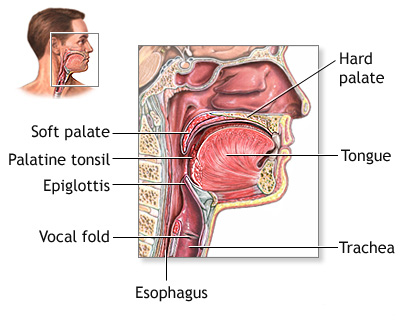
Structures of the throat include the esophagus, trachea, epiglottis and tonsils.
Causes
Enlarged adenoids may be normal. They may grow bigger when the baby grows in the womb. The adenoids help the body prevent or fight infections by removing bacteria and germs.
Infections can cause the adenoids to become swollen. The adenoids may stay enlarged even when you are not sick.
Symptoms
Children with enlarged adenoids often breathe through their mouth because their nose is blocked. Mouth breathing occurs mostly at night, but may be present during the day.
Mouth breathing may lead to the following symptoms:
Enlarged adenoids may also cause sleep problems. A child may:
Be restless while sleeping
Snore a lot
Have episodes of not breathing during sleep (sleep apnea)
Children with enlarged adenoids may also have more frequent ear infections.
Exams and Tests
The adenoids cannot be seen by looking in the mouth directly. The health care provider can see them by using a special mirror in the mouth your mouth or by inserting a flexible tube (called an endoscope) placed through the nose.