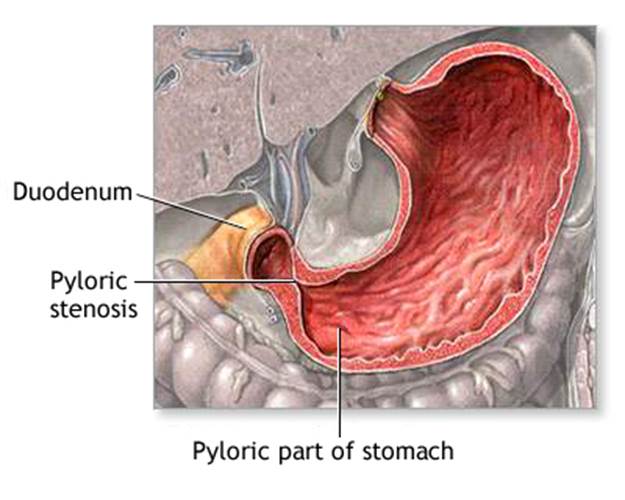
Normally, food passes easily from the stomach into the first part of the small intestine through a valve called the pylorus. With pyloric stenosis, the muscles of the pylorus are thickened. This prevents the stomach from emptying into the small intestine.
The cause of the thickening is unknown. Genes may play a role, since children of parents who had pyloric stenosis are more likely to have this condition.
Pyloric stenosis occurs most often in infants younger than 6 months. It is more common in boys than in girls.
Treatment for pyloric stenosis involves surgery to widen the pylorus. The surgery is called pyloromyotomy.
If putting the infant to sleep for surgery is not safe, a device called an endoscope with a tiny balloon at the end is used. The balloon is inflated to widen the pylorus.
In infants who cannot have surgery, tube feeding or medicine to relax the pylorus is tried.
Dehydration means your body does not have as much water and fluids as it should.
Dehydration can be mild, moderate, or severe based on how much of the body's fluid is lost or not replenished. When it is severe, dehydration is a life-threatening emergency.
Dehydration in sick children is often a combination of refusing to eat or drink anything and losing fluid from vomiting, diarrhea, or fever.
Infants and children are more likely to become dehydrated than adults because they weigh less and their bodies turn over water and electrolytes more quickly. The elderly and people with illnesses are also at higher risk.
You may also have vomiting, diarrhea, or the feeling that you "can't keep anything down." All of these can be causing the dehydration.
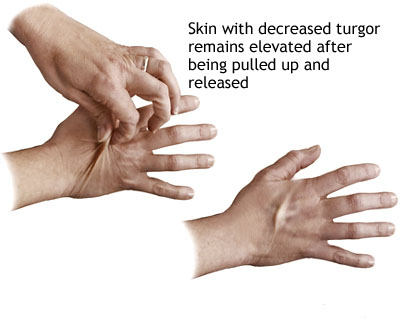
A decrease in skin turgor is indicated when the skin (on the back of the hand for an adult or on the abdomen for a child) is pulled up for a few seconds and does not return to its original state. A decrease in skin turgor is a late sign of dehydration.
Poor skin turgor -- the skin may not be as elastic as normal and sag back into position slowly when the health care provider pinches it up into a fold (normally, skin springs right back into place)
Drinking fluids is usually enough for mild dehydration. It is better to drink small amounts of fluid often (using a teaspoon or syringe for an infant or child), instead of trying to force large amounts of fluid at one time. Drinking too much fluid at once can bring on more vomiting.
Electrolyte solutions or freezer pops are very effective. These are available at pharmacies. Sports drinks contain a lot of sugar and can cause or worsen diarrhea. In infants and children, avoid using water as the primary replacement fluid.
Intravenous fluids and a hospital stay may be needed for moderate to severe dehydration. The health care provider will try to identify and then treat the cause of the dehydration.
Most cases of stomach viruses (also called viral gastroenteritis) tend to get better on their own after a few days. See also: Diarrhea
Even when you are healthy, drink plenty of fluids every day. Drink more when the weather is hot or you are exercising.
Carefully monitor someone who is ill, especially an infant, child, or older adult. If you believe that the person is getting dehydrated, call your health care provider before the person becomes dehydrated. Begin fluid replacement as soon as vomiting and diarrhea start -- DO NOT wait for signs of dehydration.
Always encourage a person who is sick to drink fluids. Remember that fluid needs are greater with a fever, vomiting, or diarrhea. The easiest signs to monitor are urine output (there should be frequent wet diapers or trips to the bathroom), saliva in the mouth, and tears when crying.
Food poisoning occurs when you swallow food or water that contains bacteria, parasites, viruses, or toxins made by these germs. Most cases of food poisoning are from common bacteria such as Staphylococcus or E. coli.
Food poisoning occurs when food contaminated with organisms is ingested. The bacteria Staphylococcus aureus can commonly be found on people, but when allowed to grow in food this bacteria can produce a toxin that causes illness such as vomiting and diarrhea. Proper hygiene and handwashing can prevent this bacteria from entering food that will be eaten. The major source of Escherichia is from the feces of infected animals. It can also be found in untreated water. Cooking at the right temperature is important in eliminating this bacteria when it has contaminated food.
Food poisoning can affect one person or a group of people who all ate the same contaminated food. It more commonly occurs after eating at picnics, school cafeterias, large social functions, or restaurants.
The germs may get into the food you eat (called contamination) in different ways:
Meat or poultry can come into contact with bacteria from the intestines of an animal that is being processed
Water that is used during growing or shipping can contain animal or human waste
Food handling or preparation in grocery stores, restaurants, or homes
Food poisoning often occurs from eating or drinking:
Any food prepared by someone who does not wash their hands properly
Any food prepared using cooking utensils, cutting boards, and other tools that are not fully cleaned
Dairy products or food containing mayonnaise that have been out of the refrigerator too long
Frozen or refrigerated foods that are not stored at the proper temperature or are not reheated properly
Raw fish
Raw fruits or vegetables that have not been washed well
Raw vegetables or fruit juices and dairy products (look for the word "pasteurized," which means the food has been treated to prevent contamination)
Undercooked meats or eggs
Water from a well or stream, or city or town water that has not been treated
Many types of germs may cause food poisoning, including:
Campylobacter enteritis
Cholera
E. coli enteritis
Fish poisoning
Staphylococcus aureus
Salmonella
Shigella
Infants and elderly people are at the greatest risk for food poisoning. You are also at higher risk if:
You have a serious medical condition, such as kidney disease or diabetes
You have a weakened immune system
Pregnant and breastfeeding women have to be especially careful to avoid food poisoning.
Symptoms from the most common types of food poisoning usually start within 2 - 6 hours of eating the food. That time may be longer or shorter, depending on the cause of the food poisoning.
Your doctor will examine you for signs of food poisoning, such as pain in the stomach and signs your body does not have as much water and fluids as it should. This is called dehydration.
Tests may be done on your stools or the food you have eaten to find out what type of germ is causing your symptoms. However, tests may not always find the cause of the diarrhea.
In more serious cases, your health care provider may order a sigmoidoscopy. A thin, hollow tube with a light on the end is placed in the anus to look for the source of bleeding or infection.
If you have diarrhea and are unable to drink or keep down fluids, you may need fluids given through a vein (by IV). This is especially true for young children.
If you take diuretics, ask your health care provider if you need to stop taking the diuretic while you have diarrhea. Never stop or change medications without first talking to your health care provider.
For the most common causes of food poisoning, your doctor will NOT prescribe antibiotics.
You can buy medicines at the drugstore that help slow diarrhea.
Do not use these medicines without talking to a doctor if you have bloody diarrhea, a fever, or the diarrhea is severe.
Most people fully recover from the most common types of food poisoning within 12 - 48 hours. Serious complications can occur, however, from certain types of food poisoning.
Death from food poisoning in people who are otherwise healthy is rare.