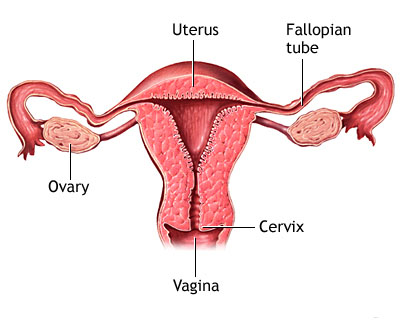
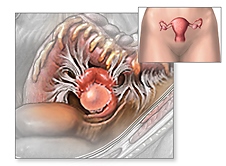
An ovarian cyst is a fluid-filled sac in or on the ovary. There are several types of ovarian cysts. Many ovarian cysts are noncancerous cysts that occur as a result of ovulation (the release of an egg from the ovary). These are called functional cysts.
Often functional cysts do not cause any symptoms (you may not even know you have one), but other times they can cause abdominal pain, bloating, menstrual irregularities, nausea and vomiting. Other symptoms include feeling full after eating just a little and constipation.
If you are menopausal and are not having periods, you shouldn't form functional cysts, but it is possible for you to form other types of ovarian cysts. You should call your doctor if you experience any of the symptoms of an ovarian cyst.
Often times, your doctor will feel a cyst during your physical exam. If you do have a cyst, your doctor will probably want you to have a sonogram so he or she can look at the cyst. What your doctor decides to do after that depends on your age, the way the cyst looks on the sonogram and if you're having symptoms.
A sonogram uses sound waves to make pictures of organs in the body. It's a good way for your doctor to look at your ovaries. This kind of sonogram can be done either through your abdomen or your vagina. Neither type is painful. The sonogram usually lasts about 30 minutes. It will give your doctor valuable information about the size and the appearance of your cyst.
Your doctor might test the level of a protein called CA-125 in your blood. Sometimes this blood test is done in women who have an ovarian cyst to see if their cyst could be cancerous. A normal CA-125 level is less than 35. However, this test is not always an accurate way to tell if a woman has ovarian cancer. For example, some women who do have ovarian cancer have a normal CA-125 level. Also, this level can sometimes be high in women who do not have cancer, particularly if they are in their childbearing years. For these reasons, the CA-125 blood test is only recommended for women who show signs or symptoms of ovarian cancer or who have genetic mutations that increase the risk of ovarian cancer.
Functional cysts normally shrink on their own over time, usually in about 1 to 3 months. If you have a functional cyst, your doctor may want to check you again in 1 to 3 months to make sure the cyst has gotten smaller. If you develop functional cysts often, your doctor may want you to take birth control pills so you won't ovulate. If you don't ovulate, you won't form functional cysts.
The treatment for ovarian cysts depends on several things, such as your age, whether you are having periods, the size of the cyst, its appearance and your symptoms.
If you're having periods, only mild symptoms and the cyst is functional, you probably won't need to have surgery. If the cyst doesn't go away after several menstrual periods, if it gets larger or if it doesn't look like a functional cyst on the sonogram, your doctor may want you to have an operation to remove it. There are many different types of ovarian cysts in women of childbearing age that do require surgery. Fortunately, cysts in women of this age are almost always benign (noncancerous).
If you're past menopause and have an ovarian cyst, your doctor will probably want you to have surgery. Ovarian cancer is rare, but women 50 to 70 years of age are at greater risk. Women who are diagnosed at an early stage do much better than women who are diagnosed later.
If the cyst is small (about the size of a plum or smaller) and if it looks benign on the sonogram, your doctor may decide to do a laparoscopy. This type of surgery is done with a lighted instrument called a laparoscope that's like a slender telescope. This is put into your abdomen through a small incision (cut) just above or just below your navel (belly button). With the laparoscope, your doctor can see your organs. Often the cyst can be removed through small incisions at the pubic hair line.
If the cyst looks too big to remove with the laparoscope or if it looks suspicious in any way, your doctor will probably do a laparotomy. A laparotomy uses a bigger incision to remove the cyst or possibly the entire affected ovary and fallopian tube. While you are under general anesthesia (which puts you in a sleep-like state) the cyst can be tested to find out if it is cancer. If it is cancer, your doctor may need to remove both of the ovaries, the uterus, a fold of fatty tissue called the omentum and some lymph nodes. It's very important that you talk to your doctor about all of this before the surgery. Your doctor will also talk to you about the risks of each kind of surgery, how long you are likely to be in the hospital and how long it will be before you can go back to your normal activities.
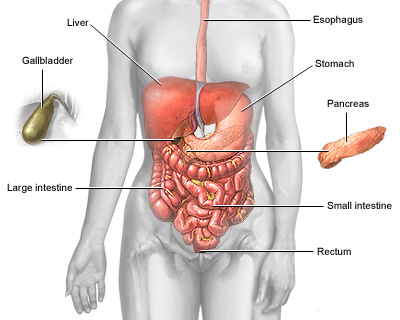
The esophagus, stomach, large and small intestine, aided by the liver, gallbladder and pancreas convert the nutritive components of food into energy and break down the non-nutritive components into waste to be excreted.
Most of the time indigestion is not a sign of a serious health problem unless it occurs with other symptoms. These may include bleeding, weight loss, or trouble swallowing.
Rarely, the discomfort of a heart attack is mistaken for indigestion.
Changing the way you eat may help your symptoms. Steps you can take include:
Allow enough time for meals.
Chew food carefully and completely.
Avoid arguments during meals.
Avoid excitement or exercise right after a meal.
Relax and get rest if indigestion is caused by stress.
Avoid aspirin and other NSAIDs. If you must take them, do so on a full stomach.
Antacids may relieve indigestion.
Medicines you can buy without a prescription, such as ranitidine (Zantac) and omeprazole (Prilosec OTC) can relieve symptoms. Your doctor may also prescribe these medicines in higher doses or for longer periods of time.
Get medical help right away if your symptoms include jaw pain, chest pain, back pain, heavy sweating, anxiety, or a feeling of impending doom. These are possible heart attack symptoms.
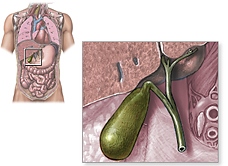
Cholangitis is an infection of the common bile duct, the tube that carries bile from the liver to the gallbladder and intestines. Bile is a liquid made by the liver that helps digest food.
Causes
Cholangitis is usually caused by a bacterial infection, which can occur when the duct is blocked by something, such as a gallstone or tumor. The infection causing this condition may also spread to the liver.
Risk factors include a previous history of gallstones, sclerosing cholangitis, HIV, narrowing of the common bile duct, and, rarely, travel to countries where you might catch a worm or parasite infection.
Call for an appointment with your health care provider if you have symptoms of cholangitis.
Prevention
Treatment of gallstones, tumors, and infestations of parasites may reduce the risk for some people. A metal or plastic stent within the bile system may be needed to prevent recurrence.
Dehydration means your body does not have as much water and fluids as it should.
Dehydration can be mild, moderate, or severe based on how much of the body's fluid is lost or not replenished. When it is severe, dehydration is a life-threatening emergency.
Dehydration in sick children is often a combination of refusing to eat or drink anything and losing fluid from vomiting, diarrhea, or fever.
Infants and children are more likely to become dehydrated than adults because they weigh less and their bodies turn over water and electrolytes more quickly. The elderly and people with illnesses are also at higher risk.
You may also have vomiting, diarrhea, or the feeling that you "can't keep anything down." All of these can be causing the dehydration.
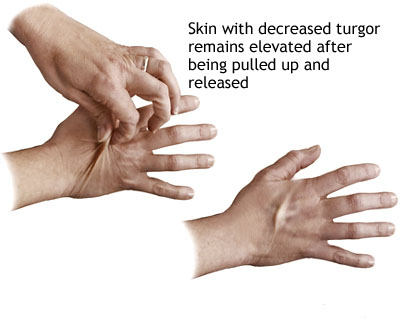
A decrease in skin turgor is indicated when the skin (on the back of the hand for an adult or on the abdomen for a child) is pulled up for a few seconds and does not return to its original state. A decrease in skin turgor is a late sign of dehydration.
Poor skin turgor -- the skin may not be as elastic as normal and sag back into position slowly when the health care provider pinches it up into a fold (normally, skin springs right back into place)
Drinking fluids is usually enough for mild dehydration. It is better to drink small amounts of fluid often (using a teaspoon or syringe for an infant or child), instead of trying to force large amounts of fluid at one time. Drinking too much fluid at once can bring on more vomiting.
Electrolyte solutions or freezer pops are very effective. These are available at pharmacies. Sports drinks contain a lot of sugar and can cause or worsen diarrhea. In infants and children, avoid using water as the primary replacement fluid.
Intravenous fluids and a hospital stay may be needed for moderate to severe dehydration. The health care provider will try to identify and then treat the cause of the dehydration.
Most cases of stomach viruses (also called viral gastroenteritis) tend to get better on their own after a few days. See also: Diarrhea
Even when you are healthy, drink plenty of fluids every day. Drink more when the weather is hot or you are exercising.
Carefully monitor someone who is ill, especially an infant, child, or older adult. If you believe that the person is getting dehydrated, call your health care provider before the person becomes dehydrated. Begin fluid replacement as soon as vomiting and diarrhea start -- DO NOT wait for signs of dehydration.
Always encourage a person who is sick to drink fluids. Remember that fluid needs are greater with a fever, vomiting, or diarrhea. The easiest signs to monitor are urine output (there should be frequent wet diapers or trips to the bathroom), saliva in the mouth, and tears when crying.
A migraine is a common type of headache that may occur with symptoms such as nausea, vomiting, or sensitivity to light. In many people, a throbbing pain is felt only on one side of the head.
Some people who get migraines have warning symptoms, called an aura, before the actual headache begins. An aura is a group of symptoms, including vision disturbances, that are a warning sign that a bad headache is coming.
Symptoms of a migraine attack may include heightened sensitivity to light and sound, nausea, auras (loss of vision in one eye or tunnel vision), difficulty of speech and intense pain predominating on one side of the head.
Migraine headaches tend to first appear between the ages of 10 and 45. Sometimes they may begin later in life.
Migraines occur more often in women than men
Migraines may run in families
Some women, but not all, may have fewer migraines when they are pregnant
A migraine is caused by abnormal brain activity, which can be triggered by a number of factors. However, the exact chain of events remains unclear. Today, most medical experts believe the attack begins in the brain, and involves nerve pathways and chemicals. The changes affect blood flow in the brain and surrounding tissues.
Alcohol, stress and anxiety, certain odors or perfumes, loud noises or bright lights, and smoking may trigger a migraine. Migraine attacks may also be triggered by:
Caffeine withdrawal
Changes in hormone levels during a woman's menstrual cycle or with the use of birth control pills
Changes in sleep patterns
Exercise or other physical stress
Missed meals
Smoking or exposure to smoke
Migraine headaches can be triggered by certain foods. The most common are:
Any processed, fermented, pickled, or marinated foods, as well as foods that contain monosodium glutamate (MSG)
Baked goods, chocolate, nuts, peanut butter, and dairy products
Foods containing tyramine, which includes red wine, aged cheese, smoked fish, chicken livers, figs, and certain beans
Fruits (avocado, banana, citrus fruit)
Meats containing nitrates (bacon, hot dogs, salami, cured meats)
Onions
This list may not include all triggers.
True migraine headaches are not a result of a brain tumor or other serious medical problem. However, only an experienced health care provider can determine whether your symptoms are due to a migraine or another condition.
Vision disturbances, or aura, are considered a "warning sign" that a migraine is coming. The aura occurs in both eyes and may involve any or all of the following:
A temporary blind spot
Blurred vision
Eye pain
Seeing stars or zigzag lines
Tunnel vision
Other warning signs include yawning, difficulty concentrating, nausea, and trouble finding the right words.
Not every person with migraines has an aura. Those who do usually develop one about 10 - 15 minutes before the headache. However, an aura may occur just a few minutes to 24 hours beforehand. A headache may not always follow an aura.
Migraine headaches can be dull or severe. The pain may be felt behind the eye or in the back of the head and neck. For many patients, the headaches start on the same side each time. The headaches usually:
Feel throbbing, pounding, or pulsating
Are worse on one side of the head
Start as a dull ache and get worse within minutes to hours
Last 6 to 48 hours
Other symptoms that may occur with the headache include:
Chills
Increased urination
Fatigue
Loss of appetite
Nausea and vomiting
Numbness, tingling, or weakness
Problems concentrating, trouble finding words
Sensitivity to light or sound
Sweating
Symptoms may linger even after the migraine has gone away. Patients with migraine sometimes call this a migraine "hangover." Symptoms can include:
Feeling mentally dull, like your thinking is not clear or sharp
Your doctor can diagnose this type of headache by asking questions about your symptoms and family history of migraines. A complete physical exam will be done to determine if your headaches are due to muscle tension, sinus problems, or a serious brain disorder.
There is no specific test to prove that your headache is actually a migraine. However, your doctor may order a brain MRI or CT scan if you have never had one before or if you have unusual symptoms with your migraine, including weakness, memory problems, or loss of alertness.
An EEG may be needed to rule out seizures. A lumbar puncture (spinal tap) might be done.
Treatment
There is no specific cure for migraine headaches. The goal is to treat your migraine symptoms right away, and to prevent symptoms by avoiding or changing your triggers.
A key step involves learning how to manage your migraines at home. A headache diary can help you identify your headache triggers. Then you and your doctor can plan how to avoid these triggers.
If you have frequent migraines, your doctor may prescribe medicine to reduce the number of attacks. You need to take the medicine every day for it to be effective. Medications may include:
Antidepressants such as amitriptyline or venlafaxine
Blood pressure medicines such as beta blockers (propanolol) or calcium channel blockers (verapamil)
Seizure medicines such as valproic acid, gabapentin, and topiramate
Botulinum toxin (Botox) injections may also help reduce migraine attacks.
Other medicines are taken at the first sign of a migraine attack. Over-the-counter pain medications such as acetaminophen, ibuprofen, or aspirin are often helpful when your migraine is mild. Be aware, however, that:
Taking medicines more than 3 days a week may lead to rebound headaches -- headaches that keep coming back.
Taking too much acetaminophen can damage your liver. Too much ibuprofen or aspirin can irritate your stomach.
If these treatments don't help, ask your doctor about prescription medicines. These include nasal sprays, suppositories, or injections. Your doctor can select from several different types of medications, including:
Triptans -- prescribed most often for stopping migraine attacks
Ergots -- contain different forms of ergotamine
Isometheptene (Midrin)
Some migraine medicines narrow your blood vessels. If you are at risk for heart attacks or have heart disease, talk with your health care provider before using these medicines. Do not take ergots if you are pregnant or planning to become pregnant.
Other medications are given to treat the symptoms of migraine. They may be used alone or along with other drugs. Medications in this group include:
Nausea medicines
Sedatives such as butalbital
Narcotic pain relievers
Feverfew is a popular herb for migraines. Several studies, but not all, support using feverfew for treating migraines. If you are interested in trying feverfew, make sure your doctor approves. Also, know that herbal remedies sold in drugstores and health food stores are not regulated. Work with a trained herbalist when selecting herbs.
Every person responds differently to treatment. Some people have rare headaches that need little to no treatment. Others need to take several medications or even go to the hospital sometimes.
Migraine headache is a risk factor for stroke in both men and women. The risk is higher in people who have migraines that occur with aura. People with migraines should avoid other risk factors for stroke, include smoking, taking birth control pills, and eating an unhealthy diet.
When to Contact a Medical Professional
Call Emergency if:
You are experiencing "the worst headache of your life"
You have speech, vision, or movement problems or loss of balance, especially if you have not had these symptoms with a migraine before
Your headaches are more severe when lying down
The headache starts very suddenly
Also, call your doctor if:
Your headache patterns or pain change
Treatments that once worked are no longer helpful
You have side effects from medication, including irregular heartbeat, pale or blue skin, extreme sleepiness, persistent cough, depression, fatigue, nausea, vomiting, diarrhea, constipation, stomach pain, cramps, dry mouth, or extreme thirst
You are pregnant or could become pregnant -- some medications should not be taken when pregnant
See the general article on headaches for more information on emergency symptoms