Appendicitis can be hard for a parent to diagnose, though. At first, it may seem a lot like stomach flu. The classic symptoms are abdominal pain, fever, and vomiting. (In rare cases, it can also cause diarrhea.) Another telltale sign — although it's not always present — is pain that begins near the belly button then gets worse and moves to the lower right part of the abdomen.
Your child's abdomen may be distended and sensitive to your touch, and he may limp or bend over on his right side if his inflamed appendix irritates the muscles that lead to his leg.
What is appendicitis?
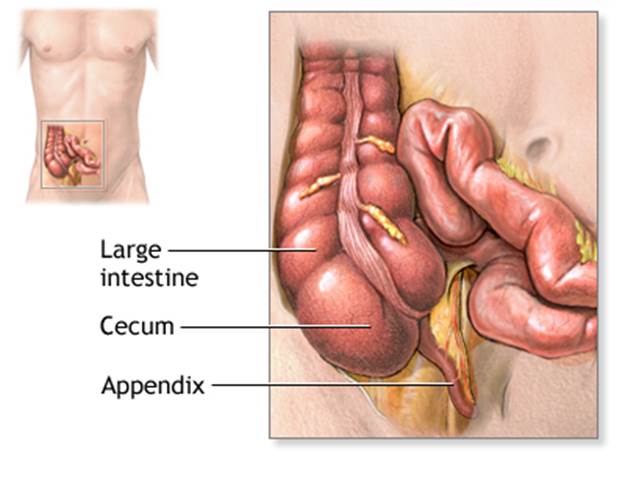
Appendicitis is the inflammation and infection of the appendix — a small, hollow, finger-shaped organ that sits at the beginning of the large intestine. This inflammation and infection can happen when bacteria get trapped in the appendix by hard stool or a large lymph node compressing and blocking the opening.
The appendix is a small, finger-shaped pouch of intestinal tissue arising from the cecum near its junction with the small intestine.
Once the appendix is infected, it must be removed to prevent it from bursting and spreading the infection into the abdomen.
How common is appendicitis?
Appendicitis is the most common cause of abdominal emergency surgery. In Western countries, 7 percent of the population will have appendicitis in their lifetime. The peak age for getting appendicitis is between 10 and 30.
The overall number of cases of appendicitis seems to be declining. Experts say this may be because people are getting more fiber in their diet, which may help prevent blockage.
Are there risk factors?
People with a family history of appendicitis seem to be more prone, and males are slightly less susceptible than females. If your child has cystic fibrosis, an inherited disease that causes digestive and respiratory problems, he's also more likely to get appendicitis.
What should I do if I think my child has appendicitis?
Call your child's doctor. She should be able to tell you whether you need to bring your child to the emergency room. It's important that appendicitis not be left untreated, because the appendix could rupture, spreading the infection into your child's abdominal cavity.
In the meantime, don't give your child laxatives or an enema. These could cause his appendix to burst. Just try to keep him calm.
Once at the hospital, the doctor will examine your child. She may do X-rays, an ultrasound, or a CAT scan — all painless procedures that can help her get a better picture of your child's appendix.
The doctor may do a blood test to see if there's an infection and a urine test to make sure that a urinary tract infection isn't responsible for your child's symptoms. She may also consult with a surgeon, who will decide whether your child needs surgery.
What's the surgery like?
Your child will be given general anesthesia, and the surgeon will make an incision in his abdominal wall. She'll then detach the appendix from the large intestine and drain any fluid that has accumulated due to the infection.
Some surgeons perform the procedure using an instrument called a laparoscope, a tiny camera on the end of a probe, which allows them to see what they're doing inside without making a large incision.
Afterward, the doctor will give your child antibiotics to prevent the incision from becoming infected. Your child will stay in the hospital for one to three days after the surgery.
What happens if my child's appendix has burst?
If the bacterial infection becomes severe, the appendix may burst, spilling the bacteria from the infected organ into the abdominal cavity. If this happens, your child will be admitted to the hospital and given an IV that will deliver antibiotics directly into his bloodstream to fight off the infection.
Surgery will still be necessary, and the surgeons will discuss with you the best timing for the procedure and the length of time your child will need IV antibiotics.
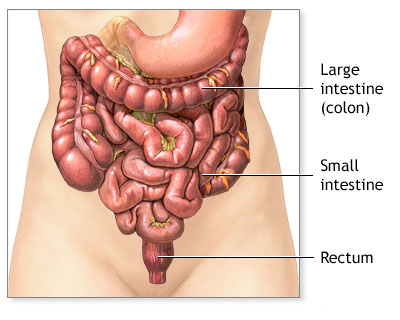
Ulcerative colitis is a type of inflammatory bowel disease (IBD) that affects the lining of the large intestine (colon) and rectum. Crohn's disease is a related condition.
Causes
The cause of ulcerative colitis is unknown. People with this condition have problems with the immune system, but it is not clear whether immune problems cause this illness. Although stress and certain foods can trigger symptoms, they do not cause ulcerative colitis.
Ulcerative colitis may affect any age group, although there are peaks at ages 15 - 30 and then again at ages 50 - 70.
The disease can begin the rectal area, and may involve the entire large intestine over time. It may also start in the rectum and other parts of the large intestine at the same time.
Risk factors include a family history of ulcerative colitis, or Jewish ancestry.
Symptoms
The symptoms vary in severity and may start slowly or suddenly. About half of people only have mild symptoms. Others have more severe attacks that occur more often. Many factors can lead to attacks, including respiratory infections or physical stress.
Colonoscopy with biopsy is generally used to diagnose ulcerative colitis.
Colonoscopy is also used to screen people with ulcerative colitis for colon cancer. Ulcerative colitis increases the risk of colon cancer. If you have this condition, you should be screened with colonoscopy about 8 - 12 years after being diagnosed. You should have a follow-up colonoscopy every 1 - 2 years.
Other tests that may be done to help diagnose this condition include:
Barium enema
Complete blood count (CBC)
C-reactive protein (CRP)
Sedimentation rate (ESR)
Treatment
The goals of treatment are to:
Control the acute attacks
Prevent repeated attacks
Help the colon heal
Hospitalization is often needed for severe attacks. Your doctor may prescribe corticosteroids to reduce inflammation. You may be given nutrients through a vein (intravenous line).
DIET AND NUTRITION
Certain types of foods may worsen diarrhea and gas symptoms, especially during times of active disease. Diet suggestions include:
Eat small amounts of food throughout the day.
Drink plenty of water (drink small amounts throughout the day).
Avoid high-fiber foods (bran, beans, nuts, seeds, and popcorn).
Avoid fatty, greasy or fried foods and sauces (butter, margarine, and heavy cream).
Limit milk products if you are lactose intolerant. Dairy products are a good source of protein and calcium.
STRESS
You may feel worried, embarrassed, or even sad or depresed about having a bowel accident. Other stressful events in your life, such as moving, or losing a job or a loved one can cause digestive problems.
Ask your doctor or nurse for tips on your to manage your stress.
MEDICATION
Medicines that may be used to decrease the number of attacks include:
5-aminosalicylates such as mesalamine or sulfazine, which can help control moderate symptoms
Immunomodulators such as azathioprine and 6-mercaptopurine
Corticosteroids (prednisone and methylprednisolone) taken by mouth during a flare-up or as a rectal suppository, foam, or enema
Infliximab (Remicade) or other biological treatments, if you do not respond to other medications
SURGERY
Surgery to remove the colon will cure ulcerative colitis and removes the threat of colon cancer. Surgery is usually recommended if you have:
Colitis that does not respond to complete medical therapy
Changes in the lining of the colon that are thought to be precancerous
Serious complications such as rupture (perforation) of the colon, severe bleeding (hemorrhage), or toxic megacolon
Most of the time, the entire colon, including the rectum, is removed (total proctocolectomy with ileostomy). Afterwards, you may need a surgical opening in the abdominal wall (ileostomy), or a procedure that connects the small intestine to the anus to gain more normal bowel function.
Outlook (Prognosis)
Symptoms are mild in about half of people with ulcerative colitis. You are less likely to respond well to medicines if your disease is more severe.
Permanent and complete control of symptoms with medications is unusual. Cure is only possible through complete removal of the large intestine.
The risk of colon cancer increases in each decade after ulcerative colitis is diagnosed.
Possible Complications
Repeated swelling (inflammation) leads to thickening of the intestinal wall and rectum with scar tissue. Death of colon tissue or severe infection (sepsis) may occur with severe disease.
Dehydration means your body does not have as much water and fluids as it should.
Dehydration can be mild, moderate, or severe based on how much of the body's fluid is lost or not replenished. When it is severe, dehydration is a life-threatening emergency.
Dehydration in sick children is often a combination of refusing to eat or drink anything and losing fluid from vomiting, diarrhea, or fever.
Infants and children are more likely to become dehydrated than adults because they weigh less and their bodies turn over water and electrolytes more quickly. The elderly and people with illnesses are also at higher risk.
You may also have vomiting, diarrhea, or the feeling that you "can't keep anything down." All of these can be causing the dehydration.
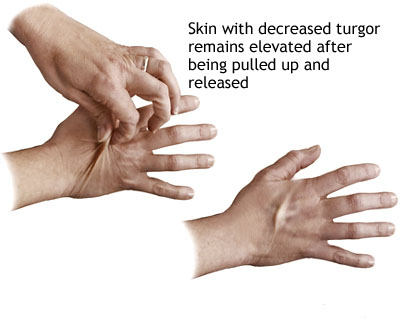
A decrease in skin turgor is indicated when the skin (on the back of the hand for an adult or on the abdomen for a child) is pulled up for a few seconds and does not return to its original state. A decrease in skin turgor is a late sign of dehydration.
Poor skin turgor -- the skin may not be as elastic as normal and sag back into position slowly when the health care provider pinches it up into a fold (normally, skin springs right back into place)
Drinking fluids is usually enough for mild dehydration. It is better to drink small amounts of fluid often (using a teaspoon or syringe for an infant or child), instead of trying to force large amounts of fluid at one time. Drinking too much fluid at once can bring on more vomiting.
Electrolyte solutions or freezer pops are very effective. These are available at pharmacies. Sports drinks contain a lot of sugar and can cause or worsen diarrhea. In infants and children, avoid using water as the primary replacement fluid.
Intravenous fluids and a hospital stay may be needed for moderate to severe dehydration. The health care provider will try to identify and then treat the cause of the dehydration.
Most cases of stomach viruses (also called viral gastroenteritis) tend to get better on their own after a few days. See also: Diarrhea
Even when you are healthy, drink plenty of fluids every day. Drink more when the weather is hot or you are exercising.
Carefully monitor someone who is ill, especially an infant, child, or older adult. If you believe that the person is getting dehydrated, call your health care provider before the person becomes dehydrated. Begin fluid replacement as soon as vomiting and diarrhea start -- DO NOT wait for signs of dehydration.
Always encourage a person who is sick to drink fluids. Remember that fluid needs are greater with a fever, vomiting, or diarrhea. The easiest signs to monitor are urine output (there should be frequent wet diapers or trips to the bathroom), saliva in the mouth, and tears when crying.
Food poisoning occurs when you swallow food or water that contains bacteria, parasites, viruses, or toxins made by these germs. Most cases of food poisoning are from common bacteria such as Staphylococcus or E. coli.
Food poisoning occurs when food contaminated with organisms is ingested. The bacteria Staphylococcus aureus can commonly be found on people, but when allowed to grow in food this bacteria can produce a toxin that causes illness such as vomiting and diarrhea. Proper hygiene and handwashing can prevent this bacteria from entering food that will be eaten. The major source of Escherichia is from the feces of infected animals. It can also be found in untreated water. Cooking at the right temperature is important in eliminating this bacteria when it has contaminated food.
Food poisoning can affect one person or a group of people who all ate the same contaminated food. It more commonly occurs after eating at picnics, school cafeterias, large social functions, or restaurants.
The germs may get into the food you eat (called contamination) in different ways:
Meat or poultry can come into contact with bacteria from the intestines of an animal that is being processed
Water that is used during growing or shipping can contain animal or human waste
Food handling or preparation in grocery stores, restaurants, or homes
Food poisoning often occurs from eating or drinking:
Any food prepared by someone who does not wash their hands properly
Any food prepared using cooking utensils, cutting boards, and other tools that are not fully cleaned
Dairy products or food containing mayonnaise that have been out of the refrigerator too long
Frozen or refrigerated foods that are not stored at the proper temperature or are not reheated properly
Raw fish
Raw fruits or vegetables that have not been washed well
Raw vegetables or fruit juices and dairy products (look for the word "pasteurized," which means the food has been treated to prevent contamination)
Undercooked meats or eggs
Water from a well or stream, or city or town water that has not been treated
Many types of germs may cause food poisoning, including:
Campylobacter enteritis
Cholera
E. coli enteritis
Fish poisoning
Staphylococcus aureus
Salmonella
Shigella
Infants and elderly people are at the greatest risk for food poisoning. You are also at higher risk if:
You have a serious medical condition, such as kidney disease or diabetes
You have a weakened immune system
Pregnant and breastfeeding women have to be especially careful to avoid food poisoning.
Symptoms from the most common types of food poisoning usually start within 2 - 6 hours of eating the food. That time may be longer or shorter, depending on the cause of the food poisoning.
Your doctor will examine you for signs of food poisoning, such as pain in the stomach and signs your body does not have as much water and fluids as it should. This is called dehydration.
Tests may be done on your stools or the food you have eaten to find out what type of germ is causing your symptoms. However, tests may not always find the cause of the diarrhea.
In more serious cases, your health care provider may order a sigmoidoscopy. A thin, hollow tube with a light on the end is placed in the anus to look for the source of bleeding or infection.
If you have diarrhea and are unable to drink or keep down fluids, you may need fluids given through a vein (by IV). This is especially true for young children.
If you take diuretics, ask your health care provider if you need to stop taking the diuretic while you have diarrhea. Never stop or change medications without first talking to your health care provider.
For the most common causes of food poisoning, your doctor will NOT prescribe antibiotics.
You can buy medicines at the drugstore that help slow diarrhea.
Do not use these medicines without talking to a doctor if you have bloody diarrhea, a fever, or the diarrhea is severe.
Most people fully recover from the most common types of food poisoning within 12 - 48 hours. Serious complications can occur, however, from certain types of food poisoning.
Death from food poisoning in people who are otherwise healthy is rare.