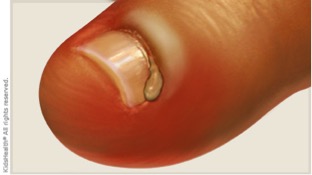
Бұл не? Паронихия - тырнақ айналасындағы тері инфекциясы (саңырауқұлақтық немесебактериальді). Бұл ауру дерматит, псориаз, қанайналу бұзылуы нәтижесінде болуы мүмкін. Ең жиі себебі Candida albicans туысындағы саңырауқұлақтар болып табылады.
Симптомдары қандай? Жедел түрінде қызару немесе ісіну симмтомдары кенеттен дамып, қысқа уақыт аралығына созылады.Созылмалы түрінде симптомдар үзіліссіз немесе кезеңді болуы мүмкін. Созылмалы паронихия – ыдыс жуушы, кір жуушы, бармен және шаштараздардың кәсіптік ауруы. Инфекцияны жұқтыру қолды ұзақ уақыт суда ұстау, жарақат, қырыну, заусеницны кесіп алуы нәтижесінде болуы мүмкін.
Нестеу керек? Аздаған қызару мен ісінуді үй жағдайында мұқият тазалау арқылы кетіруге болады. Кей жағдайда антибиотиктермен немесе саңырауқұлаққа қарсы заттармен емдеуді қажет етеді. Кейде кішігірім хирургиялық ем жасауға-зақымдалған аймақты дренаждау үшін дәрігер көмегі керек.
Тері күтімін дұрыс жүргізу үшін тұрғылықты жеріңіз бойынша тері ауруларының маманына жолығыңыз.
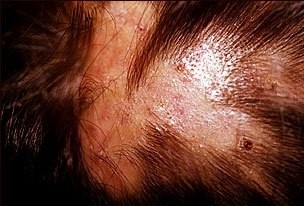
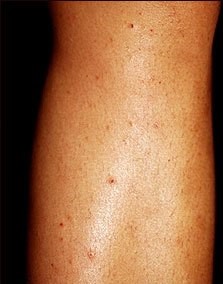
Фолликулит – бұл тері астында орналасқан шағын қалташалар - фолликулдардың инфекциясы немесе қабынуы, фоликулдарда шаш түзіліп, өседі. Фолликулит дененің кез келген бөлігінде пайда болуы мүмкін, бірақ, ол шаш түбінде, киімнің денеге үйкелетін тұстарында – мысалы, қолда, бөкседе жиі болады.
Фолликулиттің жиі себебі – бактериалдық инфекция, бірақ, зеңдік инфекциядан да туындауы мүмкін.
Фолликулит шаштың бір немесе бірнеше шумағының маңында немесе түбінде қызарған, ауырсынатын аумақ түрінде басталады. Одан кейін бұл бөлік терідегі іріңді төмпешікке (пустула) айналады, ол кейде қышып, күйдіретін сезім береді. Пустуланы ашқанда ірің және/немесе қан шығуы мүмкін.
Инфекциялық фолликулиттің терінің бетіне жақын орналасатын жеңіл жағдайлар әдетте, өздігінше, шамамен 2 аптадан кейін жазылады. Терең және күрделі инфекциялық фолликулитте әдетте, ішетін антибиотиктер мен зеңге қарсы препараттар жақсы көмектеседі.
For patients in the hospital, common sites of infection include intravenous lines, surgical wounds, surgical drains, and sites of skin breakdown, known as bedsores or pressure ulcers.
In sepsis, blood pressure drops, resulting in shock. Major organs and body systems, including the kidneys, liver, lungs, and central nervous system stop working properly because of poor blood flow.
The health care provider will examine the person and ask about the person's medical history.
The infection is often confirmed by a blood test. But a blood test may not reveal infection in people who have been receiving antibiotics. Some infections that can cause sepsis cannot be diagnosed by a blood test.
A person with sepsis will be admitted to a hospital, usually in the intensive care unit (ICU). Antibiotics are usually given through a vein (intravenously).
Oxygen is given to the person. Large amounts of fluids are given through a vein. Other medical treatments include:
Sepsis is often life threatening, especially in people with a weakened immune system or a long-term (chronic) illness.
Damage caused by a drop in blood flow to vital organs such as the brain, heart, and kidneys may take time to improve. There may be long-term problems with these organs.
The risk of sepsis can be reduced by getting all recommended vaccines.
In the hospital, careful hand washing can help prevent infections that lead to sepsis. Prompt removal of urinary catheters and IV lines when they are no longer needed can also help prevent infections that lead to sepsis.
Paronychia (pronounced: pair-uh-NIK-ee-uh) is an infection of the skin around a fingernail or toenail. The infected area can get swollen, red, and painful. Sometimes a pus-filled blister may form.
Most of the time, paronychia is no big deal and can be treated at home. In rare cases, the infection can spread to the rest of the finger or toe. When that happens, it can lead to bigger problems that may need a doctor's help.
You're not likely to get paronychia in a toe (unless you have an ingrown toenail). But fingernail paronychia is one of the most common hand infections there is.
Paronychia usually happens when the skin around a person's nail is irritated or injured. When the skin around the nail is damaged, germs can get in and cause an infection. These germs can be bacteria (causing bacterial paronychia) or fungi (causing fungal paronychia).
Common paronychia causes include:
· biting or pulling off a hangnail
· frequent sucking on a finger
· clipping a nail too short or trimming the cuticle (the skin around the sides and bottom of the nail)
· getting manicures
· having hands in water a lot (as from a job washing dishes in a restaurant)
Some people get paronychia infections after a manicure or using from chemicals in the glue used with artificial nails. Certain health conditions (like diabetes) also can make paronychia more likely. And if your hands are in water a lot (if you wash dishes at a restaurant, for example), that ups the chances of getting paronychia.
Chances are, if you have paronychia, it will be easy to recognize. There will be an area of skin around a nail that is painful and tender when you touch it. The area probably will be red and swollen and feel warm. You may see a pus-filled blister.
If the paronychia has been there a long time, the nail may turn a different color. It might not be its usual shape or might look as if it's coming away from the nail bed.
If paronychia is mild and hasn't started to spread beyond the fingernail, you can probably treat it at home. Soak the infected nail in warm water for 20 minutes a few times a day. The infection will probably heal on its own in a few days.
If paronychia doesn't get better after a week or so, call your doctor. You'll want to call a doctor right away if you have an abscess (a pus-filled area in the skin or under the nail) or if it looks like the infection has spread beyond the area of the nail.
If paronychia becomes severe and you don't see a doctor, infection can spread through the finger or toe and move into the rest of the body. Luckily, this is very rare.
Usually, a doctor or nurse practitioner will be able to diagnose paronychia just by examining the infected area. In some cases, a doctor may take a pus sample to be examined in a laboratory to determine what type of germ is causing the infection.
If you have diabetes, let your doctor know if you notice any signs of paronychia, even if it seems mild.
Don't try to puncture or cut into an abscess yourself. Doing that can lead to a more serious infection or other complications. The doctor may need to drain the abscess and possibly prescribe antibiotic medications to treat the infection. Once an abscess is treated, the finger or toe almost always heals very quickly.
If someone has fungal paronychia, a doctor may prescribe antifungal creams, lotions, or other medicines.
Here are some things that can lessen your chances of developing paronychia:
· Don't bite your nails or pick at the cuticle area around them.
· Don't cut nails too short. Trim your fingernails and toenails with clippers or manicure scissors, and smooth the sharp corners with an emery board or nail file. The best time to do this is after a bath or shower, when your nails are softer.
· Don't push your cuticles back, trim them, or use cuticle remover. Damaging your cuticles gives bacteria a way to get into your skin and cause an infection.
· If you'll be washing a lot of dishes or if your hands might be coming into contact with chemicals, wear rubber gloves.
· If you have diabetes, make sure it is under control.
· Practice good hygiene: keep your hands and feet clean and dry.
· If you get manicures or pedicures at a nail salon, consider bringing along your own clippers, nail files, and other tools.
As much as possible, try to avoid injuring your nails and the skin around them. Nails grow slowly. Any damage to them can last a long time.
Germs live everywhere. You can find germs (microbes) in the air; on food, plants and animals; in soil and water — on just about every other surface, including your body.
Most germs won't harm you. Your immune system protects you against infectious agents. However, some germs are formidable adversaries because they're constantly mutating to breach your immune system's defenses. Knowing how germs work can increase your chances of avoiding infection.
Infectious agents come in a variety of shapes and sizes. Categories include:
Bacteria
Viruses
Fungi
Protozoa
Helminths
Bacteria
Bacteria are one-celled organisms visible only with a microscope. They're so small that if you lined up a thousand of them end to end, they could fit across the end of a pencil eraser.
Not all bacteria are harmful, and some bacteria that live in your body are helpful. For instance, Lactobacillus acidophilus — a harmless bacterium that resides in your intestines — helps you digest food, destroys some disease-causing organisms and provides nutrients.
Many disease-causing bacteria produce toxins — powerful chemicals that damage cells and make you ill. Bacteria cause diseases such as:
Strep throat
Tuberculosis
Urinary tract infections
Viruses
Viruses are much smaller than cells. In fact, viruses are basically just capsules that contain genetic material. To reproduce, viruses invade cells in your body, hijacking the machinery that makes cells work. Host cells are often eventually destroyed during this process.
Viruses are responsible for causing numerous diseases, including:
AIDS
Common cold
Ebola hemorrhagic fever
Genital herpes
Influenza
Measles
Chickenpox and shingles
Antibiotics have no effect on viruses.
Fungi
There are many varieties of fungi, and we eat quite a few of them. Mushrooms are fungi, as is the mold that forms the blue or green veins in some types of cheese. And yeast, another type of fungus, is a necessary ingredient in most types of bread.
Other fungi can cause illness. One example is candida — a yeast that can cause infection. Candida can cause thrush — an infection of the mouth and throat — in infants and in people taking antibiotics or who have an impaired immune system. Fungi are also responsible for skin conditions such as athlete's foot and ringworm.
Protozoa
Protozoa are single-celled organisms that behave like tiny animals — hunting and gathering other microbes for food. Many protozoa call your intestinal tract home and are harmless. Others cause diseases, such as:
Giardia
Malaria
Toxoplasmosis
Protozoa often spend part of their life cycle outside of humans or other hosts, living in food, soil, water or insects. Some protozoa invade your body through the food you eat or the water you drink. Others, such as malaria, are transmitted by mosquitoes.
Helminths
Helminths are among the larger parasites. The word "helminth" comes from the Greek for "worm." If this parasite — or its eggs — enters your body, it takes up residence in your intestinal tract, lungs, liver, skin or brain, where it lives off your body's nutrients. Helminths include tapeworms and roundworms.
There's a difference between infection and disease. Infection, often the first step, occurs when bacteria, viruses or other microbes that cause disease enter your body and begin to multiply. Disease occurs when the cells in your body are damaged — as a result of the infection — and signs and symptoms of an illness appear.
In response to infection, your immune system springs into action. An army of white blood cells, antibodies and other mechanisms goes to work to rid your body of whatever is causing the infection. For instance, in fighting off the common cold, your body might react with fever, coughing and sneezing.
What's the best way to stay disease-free? Prevent infections. You can prevent infection through simple tactics, such as washing your hands regularly, being careful with food and water, getting vaccinations, and taking appropriate medications.
Hand-washing. Often overlooked, hand-washing is one of the easiest and most effective ways to protect yourself from germs and most infections. Wash your hands thoroughly before preparing or eating food, after coughing or sneezing, after changing a diaper, and after using the toilet. When soap and water aren't available, alcohol-based hand-sanitizing gels can offer protection.
Vaccines. Vaccination is your best line of defense for certain diseases. As researchers understand more about what causes disease, the list of vaccine-preventable diseases continues to grow. Many vaccines are given in childhood, but adults still need to be routinely vaccinated to prevent some illnesses, such as tetanus and influenza.
Medicines. Some medicines offer short-term protection from particular germs. For example, taking an anti-parasitic medication might keep you from contracting malaria if you travel to or live in a high-risk area.
Seek medical care if you suspect that you have an infection and you have experienced any of the following:
An animal or human bite
Difficulty breathing
A cough lasting longer than a week
Periods of rapid heartbeat
A rash, especially if it's accompanied by a fever
Swelling
Blurred vision or other difficulty seeing
Persistent vomiting
An unusual or severe headache
Your doctor can perform diagnostic tests to find out if you're infected, the seriousness of the infection and how best to treat that infection.
Folliculitis is inflammation of one or more hair follicles. It can occur anywhere on the skin.
Causes
Folliculitis starts when hair follicles are damaged by rubing from clothing, blockage of the follicle, or shaving. Most of the time, the damaged follicles become infected with Staphylococcus (staph) bacteria.
Barber's itch is a staph infection of the hair follicles in the beard area of the face, usually the upper lip. Shaving makes it worse. Tinea barbae is similar to barber's itch, but the infection is caused by a fungus.
Pseudofolliculitis barbae is a disorder that occurs mainly in black men. If curly beard hairs are cut too short, they may curve back into the skin and cause inflammation.
Symptoms
Common symptoms include a rash, itching, and pimples or pustules near a hair follicle in the neck, groin, or genital area. The pimples may crust over.
Exams and Tests
Your health care provider can diagnose this condition by looking at your skin. Lab tests may show which bacteria or fungus is causing the infection.
Treatment
Hot, moist compresses may help drain the affected follicles.
Treatment may include:
Antibiotics applied to the skin (mupirocin) or taken by mouth (dicloxacillin)
Antifungal medications to control the infection
Outlook (Prognosis)
Folliculitis usually responds well to treatment, but may come back.
Possible Complications
Folliculitis may return or spread to other body areas.
When to Contact a Medical Professional
Apply home treatment and call your health care provider if your symptoms:
Come back often
Get worse
Last longer than 2 or 3 days
Prevention
To prevent further damage to the hair follicles and infection:
Reduce friction from clothing
Avoid shaving the area if possible (if shaving is necessary, use a clean, new razor blade or an electric razor each time)