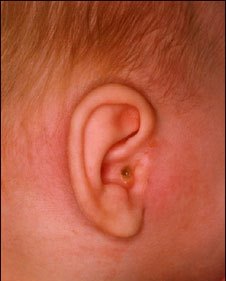
Mastoiditis is usually caused by a middle ear infection (acute otitis media). The infection may spread from the ear to the mastoid bone of the skull. The mastoid bone fills with infected materials and its honeycomb-like structure may deteriorate.
Mastoiditis usually affects children. Before antibiotics, mastoiditis was one of the leading causes of death in children. Now it is a relatively uncommon and much less dangerous condition.
Mastoiditis is an infection of the bony air cells in the mastoid bone, located just behind the ear. It is rarely seen today because of the use of antibiotics to treat ear infections. This child has drainage from the ear and redness (erythema) behind the ear over the mastoid bone.
Mastoiditis may be difficult to treat because medications may not reach deep enough into the mastoid bone. It may require repeated or long-term treatment. The infection is treated with antibiotics by injection, then antibiotics by mouth.
Surgery to remove part of the bone and drain the mastoid (mastoidectomy) may be needed if antibiotic therapy is not successful. Surgery to drain the middle ear through the eardrum (myringotomy) may be needed to treat the middle ear infection.
Benign positional vertigo is the most common type of vertigo. Vertigo is the feeling that you are spinning or that everything is spinning around you. It may occur when you move your head in a certain position.
The inner ear has fluid-filled tubes called semicircular canals. When you move, the fluid moves inside these tubes. The canals are very sensitive to any movement of the fluid. The sensation of the fluid moving in the tube tells your brain the position of your body. This helps you keep your balance.
BPPV occurs when a small piece of bone-like calcium breaks free and floats inside the tube. This sends confusing messages to your brain about your body's position.
BPPV has no major risk factors. However, your risk for developing BPPV may increase if you have:
Family members with BPPV
Had a prior head injury (even a slight bump to the head)
Benign positional vertigo is also called benign paroxysmal positional vertigo (BPPV). It is caused by a problem in the inner ear.
The inner ear has fluid-filled tubes called semicircular canals. When you move, the fluid moves inside these tubes. The canals are very sensitive to any movement of the fluid. The sensation of the fluid moving in the tube tells your brain the position of your body. This helps you keep your balance.
BPPV occurs when a small piece of bone-like calcium breaks free and floats inside the tube. This sends confusing messages to your brain about your body's position.
BPPV has no major risk factors. However, your risk for developing BPPV may increase if you have:
Family members with BPPV
Had a prior head injury (even a slight bump to the head)
Vision problems, such as a feeling that things are jumping or moving
The spinning sensation:
Is usually triggered by moving your head
Often starts suddenly
Lasts a few seconds to minutes
Certain positions can trigger the spinning feeling:
Rolling over in bed
Tilting your head up to look at something
Exams and Tests
To diagnose BPPV, your health care provider may perform a test called the Dix-Hallpike maneuver.
Your provider holds your head in a certain position. Then you are asked to lie quickly backward over a table.
As you do this, your provider will look for abnormal eye movements and ask if you feel like you are spinning.
If the Dix-Hallpike test doesn't show a clear result, you may be asked to do other tests.
Your provider will do a physical exam and ask about your medical history. You may have brain and nervous system (neurological) tests to rule out other causes. These may include:
EEG
Electronystagmography (ENG)
Head CT
Head MRI
Hearing test
Magnetic resonance angiography of the head
Warming and cooling the inner ear with water or air to test eye movements. This is called caloric stimulation.
Treatment
Your provider will do a procedure called Epley's maneuver. It can move the small piece of calcium that is floating inside your inner ear. This treatment works best to cure BPPV. Other exercises don't work as well.
Some medicines can help relieve spinning sensations.
Antihistamines
Anticholinergics
Sedative-hypnotics
However, these medicines often do not work well for treating vertigo.
To keep your symptoms from getting worse, avoid the positions that trigger it.
Outlook (Prognosis)
BPPV is uncomfortable, but it can usually be treated with Epley's maneuver. It may come back again without warning.
Possible Complications
People with severe vertigo may get dehydrated due to frequent vomiting.
When to Contact a Medical Professional
Call your health care provider if:
You develop vertigo
Treatment for vertigo doesn't work
Get immediate medical help if you also have symptoms such as:
Weakness
Slurred speech
Vision problems
These may be signs of a more serious condition.
Prevention
Avoid head positions that trigger positional vertigo.