Tinnitus is the medical term for "hearing" noises in your ears when there is no outside source of the sounds.
Tinnitus is often described as a ringing in the ears. It also can sound like roaring, clicking, hissing, or buzzing. It may be soft or loud, high pitched or low pitched. You might hear it in either one or both ears.
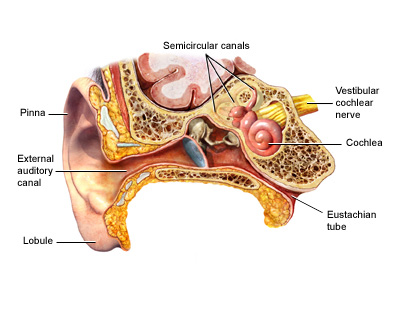
The ear consists of external, middle, and inner structures. The eardrum and the 3 tiny bones conduct sound from the eardrum to the cochlea.
The noises you hear can be soft or loud. They may sound like ringing, blowing, roaring, buzzing, hissing, humming, whistling, or sizzling. You may even think you are hearing air escaping, water running, the inside of a seashell, or musical notes.
Considerations
Tinnitus is common. Almost everyone notices a mild form of tinnitus once in a while that only lasts a few minutes. However, constant or recurring tinnitus is stressful and make it harder to focus or sleep.
Causes
It is not known exactly what causes a person to "hear" sounds with no outside source of the noise. However, tinnitus can be a symptom of almost any ear problem, including:
Meniere's disease -- an inner ear disorder that involves hearing loss and dizziness
Alcohol, caffeine, antibiotics, aspirin, or other drugs can also cause ear noises.
Tinnitus may occur with hearing loss. Sometimes, it is a sign of high blood pressure, an allergy, or anemia. Rarely, tinnitus is a sign of a serious problem like a tumor or aneurysm.
Home Care
Tinnitus can be masked by competing sounds:
Low-level music, ticking clocks, or other noises may help you not notice the tinnitus.
Tinnitus is often more noticeable when you go to bed at night because your surroundings are quieter. Any noise in the room, like a humidifier, white noise machine, or dishwasher, can help mask tinnitus and make it less irritating.
Learn ways to relax. Stress does not cause tinnitus, but feeling stressed or anxious can worsen it.
Avoid caffeine, alcohol, and smoking.
Get enough rest. Try sleeping with your head propped up in an elevated position. This lessens head congestion and noises may become less noticeable.
Protect your ears and hearing from further damage. Avoid loud places and sounds. Use earplugs if you need them.
When to Contact a Medical Professional
Call your doctor or nurse if:
Ear noises start after a head injury.
The noises occur with other unexplained symptoms like dizziness, feeling off balance, nausea, or vomiting.
You have unexplained ear noises that bother you even after self-help measures.
The noise is only in one ear and continues for several weeks or long.
If your doctor can determine the cause, fixing the problem (for example, removing ear wax) may make your symptoms go away.
Review all of your current medicines, including over-the-counter drugs, vitamins, and supplements with your health care provider. Do not stop taking any medications without first talking to your provider.
Many medicines have been used to relieve symptoms of tinnitus, but no drug works for everyone.
A tinnitus masker worn like a hearing aid helps some people. It delivers low-level sound directly into the ear to cover or disguise the ear noise that is bothering you.
A hearing aid may help reduce ear noise and make outside sounds louder.
Sometimes, counseling may help you learn to live with tinnitus. Your doctor may recommend biofeedback training to help with stress.
Some people have tried alternative therapies to treat tinnitus. However, such methods have not been proven. Talk to your doctor before trying any of these alternative therapies.
The American Tinnitus Association offers a good resource center and support group.
Prevention
Wear ear protection in any situations where ear damage is possible (such as loud concerts or jackhammers). If you have hearing loss, avoid further damage to your hearing by avoiding excessive noise.
Alternative Names
Ringing in the ears; Noises or buzzing in the ears; Ear buzzing
Benign positional vertigo is the most common type of vertigo. Vertigo is the feeling that you are spinning or that everything is spinning around you. It may occur when you move your head in a certain position.
The inner ear has fluid-filled tubes called semicircular canals. When you move, the fluid moves inside these tubes. The canals are very sensitive to any movement of the fluid. The sensation of the fluid moving in the tube tells your brain the position of your body. This helps you keep your balance.
BPPV occurs when a small piece of bone-like calcium breaks free and floats inside the tube. This sends confusing messages to your brain about your body's position.
BPPV has no major risk factors. However, your risk for developing BPPV may increase if you have:
Family members with BPPV
Had a prior head injury (even a slight bump to the head)
Benign positional vertigo is also called benign paroxysmal positional vertigo (BPPV). It is caused by a problem in the inner ear.
The inner ear has fluid-filled tubes called semicircular canals. When you move, the fluid moves inside these tubes. The canals are very sensitive to any movement of the fluid. The sensation of the fluid moving in the tube tells your brain the position of your body. This helps you keep your balance.
BPPV occurs when a small piece of bone-like calcium breaks free and floats inside the tube. This sends confusing messages to your brain about your body's position.
BPPV has no major risk factors. However, your risk for developing BPPV may increase if you have:
Family members with BPPV
Had a prior head injury (even a slight bump to the head)
Vision problems, such as a feeling that things are jumping or moving
The spinning sensation:
Is usually triggered by moving your head
Often starts suddenly
Lasts a few seconds to minutes
Certain positions can trigger the spinning feeling:
Rolling over in bed
Tilting your head up to look at something
Exams and Tests
To diagnose BPPV, your health care provider may perform a test called the Dix-Hallpike maneuver.
Your provider holds your head in a certain position. Then you are asked to lie quickly backward over a table.
As you do this, your provider will look for abnormal eye movements and ask if you feel like you are spinning.
If the Dix-Hallpike test doesn't show a clear result, you may be asked to do other tests.
Your provider will do a physical exam and ask about your medical history. You may have brain and nervous system (neurological) tests to rule out other causes. These may include:
EEG
Electronystagmography (ENG)
Head CT
Head MRI
Hearing test
Magnetic resonance angiography of the head
Warming and cooling the inner ear with water or air to test eye movements. This is called caloric stimulation.
Treatment
Your provider will do a procedure called Epley's maneuver. It can move the small piece of calcium that is floating inside your inner ear. This treatment works best to cure BPPV. Other exercises don't work as well.
Some medicines can help relieve spinning sensations.
Antihistamines
Anticholinergics
Sedative-hypnotics
However, these medicines often do not work well for treating vertigo.
To keep your symptoms from getting worse, avoid the positions that trigger it.
Outlook (Prognosis)
BPPV is uncomfortable, but it can usually be treated with Epley's maneuver. It may come back again without warning.
Possible Complications
People with severe vertigo may get dehydrated due to frequent vomiting.
When to Contact a Medical Professional
Call your health care provider if:
You develop vertigo
Treatment for vertigo doesn't work
Get immediate medical help if you also have symptoms such as:
Weakness
Slurred speech
Vision problems
These may be signs of a more serious condition.
Prevention
Avoid head positions that trigger positional vertigo.