You might not be Atlas, but your shoulders still carry a lot of weight. If it weren't for them, you wouldn't be able to pitch a game-winning home run, shovel snow off your front walk, or even comb your hair.
The shoulders' ball-and-socket design gives you great range of motion, but at the expense of stability. The shoulder socket is shaped like a golf tee, fairly flat on top, so the ball of the upper arm bone can easily slip out of it. That instability is why the shoulder joint gets dislocated more often than any other joint in the body.
When you lift weights every day or pitch every weekend, you can put a lot of wear and tear on your shoulder muscles, tendons, and joints. This is especially true if your form or technique is incorrect. Repetitive stress can lead to tears and other injuries, which can take you off the playing field and leave you in serious pain.
Here's a guide to the most common shoulder injuries -- how to spot them, and what to do about them.
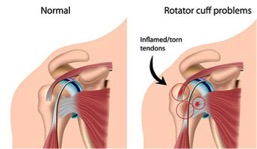
What it is: Your rotator cuff is the set of four muscles that sits around the ball of the shoulder joint and allows the shoulder to move.
How it can get injured: Sports that involve lifting your hands over your head -- like pitching in baseball, swimming the freestyle or butterfly stroke, serving in tennis, and weight lifting -- can cause the top part of the shoulder blade to pinch the rotator cuff muscles. This is called shoulder impingement.
Repetitive motion in sports can also overload the tendons of the rotator cuff. Those tendons can eventually swell and get inflamed -- a condition called tendinitis. If you ignore the pain and keep swinging that golf club or tennis racket, the tendon that connects the rotator cuff muscles to the ball part of the joint can eventually tear.
What you'll feel: Pain is the main symptom of a rotator cuff injury. The pain gets worse when you raise your arm, and you might hear a click or popping sound. Eventually, the shoulder will hurt even when you're not moving it. A rotator cuff injury can limit your shoulder movement and reduce your strength.
How it's treated: Your doctor may suggest that you rest your shoulder for a few days, then begin rotator cuff stretching and mobility exercises. Avoid lifting anything above shoulder level until the injury heals. An anti-inflammatory medication or corticosteroid injection may help bring down swelling and reduce pain.
If the pain and weakness do not improve, you might need more formal physical therapy or surgery. The type of surgery done depends on the size, type, and location of the tear. It can take several weeks or even months for a rotator cuff injury to heal.
How to prevent it: Exercise your rotator cuff muscles to keep them strong and improve your range of motion. Be careful when you play sports like golf and tennis that use the same repetitive motions. Switch up your game once in a while. And stop whenever you feel pain.
AC Joint Injury
What it is: The AC (acromioclavicular) joint is located where the uppermost part of your shoulder blade -- a structure called the acromion -- meets your collarbone. When ligaments connecting the acromion and collarbone get torn, you've got a separated shoulder.
How it can get injured: Getting hit hard in the shoulder or falling on an outstretched hand can cause a separated shoulder.
What you'll feel: Pain in your shoulder. You might also see a bump on top of the shoulder where it's separated.
How it's treated: You will need to see your doctor if you suspect you have an AC joint injury. You will likely need to wear a sling to keep your shoulder still. Ice the area for about 20-30 minutes every couple of hours to reduce swelling. Take acetaminophen or a nonsteroidal anti-inflammatory drug like ibuprofen to help with the pain.
How to prevent it: Do range-of-motion and strengthening exercises. Gradually increase the weight and number of reps to strengthen your shoulder.
What it is: A dislocated shoulder happens when the top of the upper arm bone (the ball) slips out of its socket. The ball can slip forward, backward, or downward. Before you fully dislocate it, the shoulder might feel like it's starting to go out of place. That's called instability. When the shoulder slips only partway out of the socket, it's a subluxation.
How it can get injured: A strong hit to your shoulder on the football field or ice hockey rink can pop the ball out of its socket. You can also get a dislocated shoulder if you rotate your shoulder joint too far, like when you're serving in volleyball.
What you'll feel: You can feel when your shoulder pops out of place. The pop will be followed by intense pain. You might also have swelling, bruising, and weakness in the arm.
How it's treated: Sometimes, medical personnel can pull a dislocated shoulder back into place, but don't let anyone work on your shoulder unless you're sure he or she is experienced with the procedure. Otherwise, you could end up with an even worse injury. Instead see a health care provider who will give you a sedative or pain medicine before sliding your upper arm bone gently back into its socket. You'll have to keep the shoulder still for a few weeks afterward in a sling.
If the shoulder is being stubborn and it won't go back in place, you may need surgery to relocate the joint. Surgery can also repair torn ligaments or tendons in your shoulder.
How to prevent it: Check with your doctor to see when and how much you can use your shoulder. Once you've fully healed, he may suggest start exercising your shoulder to keep it flexible. Slowly add in weights and resistance bands to increase shoulder strength if OK with your doctor or physical therapist. If your shoulder has been dislocated before, ease off on the sports until it heals. That can take a few weeks. Anyone who's had a dislocation once has a good chance of it happening again. When you do start playing contact sports again, wear shoulder pads or other protective gear.
Shoulder impingement syndrome is pain and often weakness when you raise your arm, caused by a muscle tendon "catching" in your shoulder.
It involves the rotator cuff tendon – a tough, rubbery cord that connects the muscles in your shoulder to the top of your arm. The tendon and muscle run through a narrow space at the top of the shoulder called the subacromial space.
In shoulder impingement syndrome, the tendon becomes trapped in this space and repeatedly scrapes against the bone above, causing pain that tends to be worse when you raise your arm over your head.
You may also experience a persistent ache in your shoulder and pain at night.
Shoulder impingement syndrome can start suddenly after an injury, or (generally from middle age onwards) it can come on gradually without any obvious cause.
The subacromial space is naturally quite narrow, especially when the arm is raised. Anything that further narrows this space can cause the tendon to become trapped.
They should be able to diagnose shoulder impingement syndrome by asking about your symptoms and examining your shoulder. You may also be asked to do some specific arm movements to help them work out the cause of your pain.
If the cause of your pain is unclear, your GP may refer you for a specialist assessment by a shoulder surgeon, who may also carry out some scans of your shoulder. This can help to rule out other possible causes of shoulder pain.
If shoulder impingement syndrome is only mild, the following measures may be all that are needed:
Exercises
While it's important to rest the shoulder joint, you shouldn't stop movement altogether. Inactivity will cause the muscles to weaken, which will worsen the problem and cause your shoulder to stiffen up. For this reason, a sling is not usually recommended.
Your GP may refer you to a physiotherapist, who will be able to recommend some arm exercises to help stretch and strengthen your shoulder, and improve your range of movement.
After an initial period of supervision by a physiotherapist, you will usually be able to continue doing these exercises at home.
Corticosteroids are medications that can be used to reduce inflammation and relieve pain. If there is swelling and evidence of inflammation in your shoulder, corticosteroids can be injected directly into the affected area.
They may also be combined with local anaesthetic to further help relieve your pain.
Although corticosteroid injections can relieve pain, without physiotherapy they do not have a long-term effect, and it's common for the pain to return. You can sometimes have another injection, but you will need to wait at least six weeks. Usually, no more than one to two injections into the same area are recommended.
Possible side effects of corticosteroid injections include thinning and lightening of the skin.
Surgery
If the treatments above aren't effective, you may need an operation to widen the subacromial space in your shoulder, so the rotator cuff tendon is no longer rubbing against the bone above. This is known as subacromial decompression.
This can usually be done using a technique called arthroscopy, which is a type of keyhole surgery carried out under general anaesthetic, where special surgical instruments and a thin, flexible tube containing a camera are inserted through small cuts in your skin.
This means you should recover faster and with less scarring than if a larger cut was made. Most people are able to go home the same day or the day after.
This technique can also be used to remove any calcium deposits that have formed in the tendon in your shoulder.
Отделение плеча, которое происходит, когда внешний конец ключицы отделяется от конца лопатки (акромиома) вследствие разрыва связок. Эта травма чаще всего происходит при ударе по плечу или падении на плечо, либо растяжении кисти руки или всей руки.
Выхода из своего нормального положения или надавливания костей, при котором происходит перемещение плеча вверх (смещение).
Если боль при треске или щелканье отсутствует, то это может означать что связки вышли из своего нормального положения, но остались целыми. Скрежет в плече может возникнуть при перемещении суставов и при других состояниях, например, при артрите, бурсите, или при разрыве манжеты вращательной мышцы. Если никаких других симптомов кроме треска, щелканья или скрежета нет, то достаточным будет домашнее лечение.
Быстрое лечение может предотвратить дальнейшие осложнения и ускорить заживление.
Что это такое?
Кальциевый тендинит – это заболевание, вызванное отложением кальция в местах воспаления и нарушением кровоснабжения. Это ведет к разрыву тканей вследствие дегенеративных изменений и дальнейшему откладыванию кальция.
Возможные симптомы:
Боль в плече, которая повторяется с периодичностью, но обычно длится лишь 1-2 недели. Боль часто наблюдается ночью и ведет к нарушениям сна.
Периодическое ограничение подвижности плеча. Вероятность возникновения кальциевого тендинита у женщин выше, чем у мужчин. В лечение входят покой, прикладывание холода, болеутоляющие лекарства и препараты для уменьшения отека, легкие упражнения и иногда инъекции стероидных гормонов.
В отдельных случаях рекомендуют хирургическое удаление отложений кальция, особенно если эти отложения весьма объемны и мешают движению.