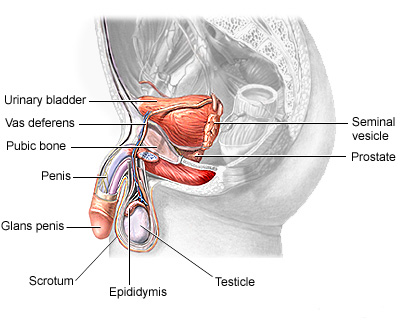
Epididymitis is most common in young men ages 19 - 35. It is a major cause of hospital admissions in the military.
Epididymitis is usually caused by the spread of a bacterial infection from the urethra, prostate, or the bladder. The most common infections that cause this condition in young heterosexual men are gonorrhea andchlamydia. In children and older men,E. coli and similar infections are much more common. This is also true in homosexual men.
Mycobacterium tuberculosis (TB) can cause epididymitis. Other bacteria (such as Ureaplasma) may also cause the condition.
Another cause of epididymitis is the use of a medication called amiodarone, which prevents abnormal heart rhythms.
The following increase the risk for epididymitis:
Being uncircumcised
Recent surgery or a history of structural problems in the urinary tract
Epididymitis may begin with a low-grade fever, chills, and a heavy sensation in the testicle area. The area becomes more and more sensitive to pressure.
Physical examination shows a red, tender, and sometimes swollen lump (mass) on the affected side of the scrotum. Tenderness is usually in a small area of the testicle where the epididymis is attached.
There may be enlarged lymph nodes in the groin area (inguinal nodes), and a discharge from the penis. A rectal examination may show an enlarged or tender prostate.
Urinalysis and culture (you may need to give several specimens, including initial stream, mid-stream, and after a prostate massage)
Tests for chlamydia and gonorrhea
It is important to distinguish this condition from testicular torsion. Testicular torsion is an emergency and should be treated with surgery as soon as possible.
Your health care provider will prescribe medications to treat the infection. Sexually-transmitted infections require specific antibiotics. Your sexual partners should also be treated. You may need pain medications and anti-inflammatory medications.
The treatment for epididymitis caused by the medication amiodarone is a lower dose or change in the medication.
Bed rest, while elevating the scrotum and applying ice packs to the area, is recommended. It is very important to have a follow-up visit with your health care provider to find out whether the infection has gone away completely.
Epididymitis usually gets better with antibiotic treatment. There usually is no reduction in sexual or reproductive abilities. However, the condition may return.
If not treated, or in some other cases, the condition can become long-term (chronic). In chronic cases, there is usually no swelling, but there is pain.
Call your health care provider if you develop symptoms of epididymitis. Go to the emergency room or call the local emergency number if you have severe testicle pain suddenly or after an injury.
You can prevent complications from epididymitis by getting diagnosed early, and by treating any infections.
Your doctor may prescribe antibiotics before a surgery that increases the risk for epididymitis. Practicing safe sex (having intercourse with only one partner at a time, using condoms) may help prevent epididymitis caused by sexually-transmitted diseases.
Urethral stricture is an abnormal narrowing of the tube that carries urine out of the body from the bladder (urethra).
CAUSES
Urethral stricture may be caused by inflammation or scar tissue from surgery, disease, or injury. It may also be caused by pressure from a growing tumor near the urethra, although this is rare.
Other risks include:
Sexually transmitted infection
Procedures that place a tube into the urethra (such as a catheter or cystoscope)
The urethra may be widened (dilated) during cystoscopy by inserting a thin instrument to stretch the urethra while you are under local anesthesia. You may be able to treat your stricture by learning to dilate the urethra at home.
If urethral dilation is not successful or possible, you may need surgery to correct the condition. Surgical options depend on the location and length of the stricture. If the stricture is short and not near the urinary sphincter, options include cutting the stricture via cystoscopy or inserting a dilating device.
An open urethroplasty may be done for longer strictures. This surgery involves removal of the diseased part followed by reconstruction. The results vary depending on the size and location, the number of treatments you have had, and the surgeon's experience.
In cases of acute urinary retention, a suprapubic catheter may be placed as an emergency treatment. This allows the bladder to drain through the abdomen.
There are currently no drug treatments for this disease. If all else fails, a urinary diversion -- appendicovesicostomy -- may be done. This allows you to perform self-catheterization of the bladder through the wall of the abdomen.
PROGNOSIS
Treatment usually results in an excellent outcome. However, repeated therapies may be needed to remove the scar tissue.
POSSIBLE COMPLICATIONS
Urethral stricture may totally block urine flow, causing acute urinary retention. This condition must be treated quickly.
WHEN TO CONTACT A DOCTOR
Call your health care provider if symptoms of urethral stricture occur.
PREVENTION
Practicing safer-sex behaviors may decrease the risk of getting sexually transmitted infections and urethral stricture.
Treating urethral stricture quickly may prevent kidney or bladder complications.