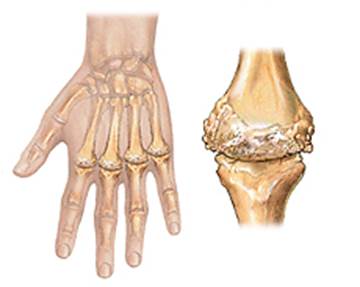
Rheumatoid arthritis (RA) is an autoimmune disease that causes inflammation and pain in your joints. It can also affect other parts of your body, such as the lining of your heart and lungs.
The hands, wrists, feet and knees are usually the first joints affected. RA usually affects several joints at the same time, on both sides of your body. For example, both of your wrists may be painful and stiff. Over time, it may also affect larger joints, such as your jaw, shoulders and hips.
Your doctor will ask you about your symptoms and may give you a physical exam. He or she may also order blood tests, a joint fluid analysis (which tests the fluid in your joints for other possible causes of your pain) and X-rays to help make a diagnosis.
Medicines you can buy without a prescription that reduce inflammation, such as aspirin, ibuprofen, or relieve pain, such as acetaminophen, can help you feel better. Your doctor can also prescribe medicine for you, such as prescription pain relievers or prescription nonsteroidal anti-inflammatory drugs (NSAIDs). These medicines reduce pain and swelling, but they do not slow the damage to your joints. These medicines should be used wisely. You only need the amount that makes you feel well enough to keep moving. Using too much medicine may increase the risk of side effects.
Medicines that manage your immune system (called immunosuppressants) can also be used to fight RA. When you have RA, your immune system is out of control. These drugs bring it back to normal. However, these medicines can lower your immune system's response to infections.
If you have only a few sore joints, your doctor may prescribe steroids (such as prednisone). Steroids reduce pain and swelling and slow the damage to your joints, but they can only be used for a little while. The longer steroids are used (many months or years), the less effective they become. They can also cause side effects, such as easy bruising, bone thinning, cataracts and diabetes.
Antirheumatic (say: "anti-roo-mat-ick") medicines can help fight RA. If these medicines are started early enough, they can slow the damage to your joints. These medicines work slowly, and it can take a few weeks to start feeling better. Your doctor may do a blood test to make sure these medicines are safe for you. Some of these medicines should not be taken if you are pregnant. Your doctor may talk to you about birth control before you use any antirheumatic medicines.
Surgery may be an option for cases of RA that are not effectively treated with medicine. Surgery can help you regain joint movement, ease pain and correct deformities caused by RA. Ask your doctor about the benefits and risks of surgery.
Talk to your doctor about all the treatment options for RA.
RA is a lifelong disease. Sometimes, if it's treated, it will go away for a little while, but it usually comes back. It is important to see your doctor as soon as you begin to experience symptoms.
Regular, gentle exercise can strengthen the muscles around your joints and relieve fatigue. Mild water aerobics or walking are good exercises to start with. Stop if you feel pain in a new joint while exercising. If the pain does not get better, you should call your doctor.
Losing weight if you are overweight and eating a healthy diet can also help RA.
In order to lessen the stress on affected joints, you can use devices to help you do everyday activities. Grabbing tools can help you pick items up. Canes can make walking easier. Ask your doctor about the tools that are available to make your daily life easier.
To ease pain, you can also apply heat or cold to your painful joints. Heat relaxes tense muscle and cold can numb pain. An easy way to apply heat is to take a 15-minute hot shower or bath. Cold packs or soaking joints in cold water are effective ways to apply cold treatment. However, you should not use these methods if you have poor circulation.
What can I do?
Exercise regularly.
Lose weight if you are overweight.
Eat a healthy diet.
Use heat to reduce pain and stiffness (such as a hot shower or a heating pad).
RA can cause other health problems. Your hands may become bent or twisted (deformed). Lung and heart problems may also occur. Talk to your doctor if you notice any new symptoms or problems.
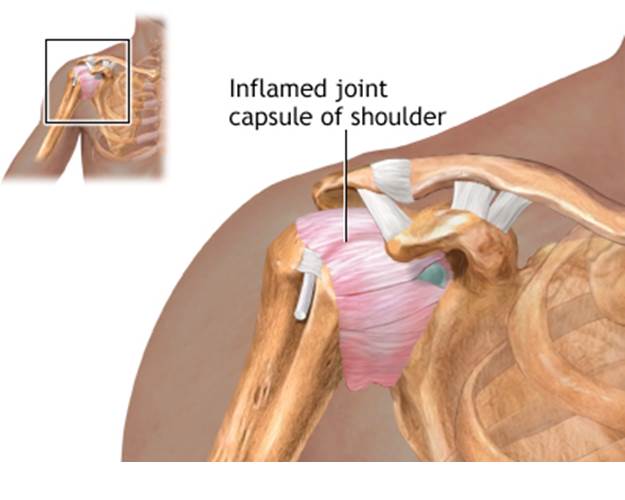
Adhesive capsulitis is when you lose the ability to move your shoulder around in all directions without pain. Doctors sometimes refer to this problem as "frozen shoulder" because your shoulder can become stiff and it may be difficult for you to move it at all.
No, sometimes adhesive capsulitis can cause your shoulder to just stop moving. This happens because if you don't use your shoulder enough (because it hurts to move) or if you use it the wrong way, your shoulder will develop scar tissue that stops it from moving around easily. Your shoulder may go through several stages as the scar tissue forms, and it may get better on its own.
1. The painful stage. At first, your shoulder may ache and feel stiff. Then it may get very painful. This stage may last about 3 to 8 months.
2. The adhesive stage. During the second stage, you may not actually have as much pain, but your shoulder keeps getting stiffer. This stage usually lasts about 4 to 6 months.
3. The recovery stage. The final stage, which usually lasts about 1 to 3 months, isn't very painful. It becomes very hard to move your shoulder even a little bit. Then after a while, the stiffness slowly goes away. You can move your shoulder again.
Although you may not get the full movement of your shoulder back, you should be able to do many more activities. As your shoulder movement increases, you may still have pain at times.
Adhesive capsulitis develops when the connective tissue in your shoulder joint tightens and restricts your joint's movement. Often, this occurs after a time when you have been less active because of another injury, such as a rotator cuff injury, broken arm or recovering from a surgery.
People 40 years of age and older are at higher risk for adhesive capsulitis, especially women. Certain health conditions, including diabetes, can also put you at higher risk.
Your doctor may be able to tell you have adhesive capsulitis just by talking to you about your symptoms and watching you move. Your doctor may press on parts of your shoulder to see what might be causing the pain. Your doctor may also want to take an X-ray or do a magnetic resonance imaging (MRI) scan of your shoulder to look for other problems.
Your doctor will tell you about exercises you can do to help break up the scar tissue in your shoulder. You may need to see a physical therapist to help you with these exercises. You can try the exercises listed below at home, but remember to always follow your doctor's instructions.
Sometimes the exercises hurt, so your doctor may give you something for the pain or to relax your muscles. Putting a heating pad or an ice pack on your shoulder for a few minutes before you do the exercise may also help with the pain. Always remember to warm up for 5 to 10 minutes before starting your exercises. Warm up by doing very gentle exercises and small movements with your shoulder. Don't forget to warm up and stretch other parts of your body (neck, back, hands and elbows), too.
Climbing the wall: Put your hand flat on a wall in front of you. Use your fingers to "climb" up the wall (like a "spider"). As you move your fingers up little by little, stop and hold your hand in place for 30 seconds every few inches. Move your fingers up the wall as high as you can reach. Keep trying to go higher.
Codman exercise: Sit sideways in a straight chair. Rest your armpit on the back of the chair. Now swing your arm slowly in circles. Make little circles at first and then make bigger circles. Make the circles in both directions.
Reaching: Put things you use every day (shoes, coffee cup, toothbrush) on a high shelf. This way you have to reach up for things more often. The reaching is a good stretch for your shoulder.
Do the exercises once or twice a day even after your shoulder gets better. Don't forget to exercise your healthy shoulder too, so that you can maintain the movement that you have in that shoulder.
Many people who have adhesive capsulitis get full use of their shoulder back. Others may always have a little stiffness and pain in that shoulder. This stiffness is usually not very bad. You should be able to do all the activities you did before you had adhesive capsulitis.