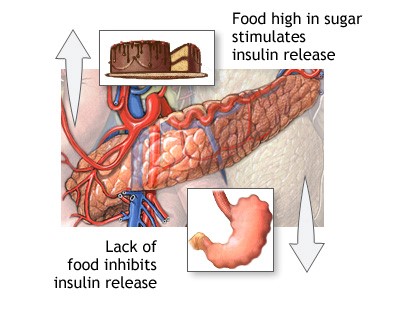
The pancreas is an organ in the abdomen. The pancreas makes several enzymes and hormones, including the hormone insulin. Insulin's job is to reduce the level of sugar (glucose) in the blood by helping it move into cells.
Most of the time when your blood sugar level drops too low, the pancreas stops making insulin until your blood sugar returns to normal. Tumors of the pancreas that produce too much insulin are called insulinomas. Insulinomas keep making insulin, even when your blood sugar drops too low.
A high blood insulin level causes a low blood sugar level (hypoglycemia). Hypoglycemia may be mild, leading to symptoms such as anxiety and hunger. Or it can be severe, leading to seizures, coma, and even death.
Insulinomas are rare tumors. They usually occur as single, small tumors in adults.
These tumors are very rare in children. Most children with high blood insulin levels have many areas of overactive insulin-releasing cells in the pancreas, instead of a single tumor.
CT or MRI scan of the abdomen, or PET scan may be done to look for a tumor in the pancreas. If the test is negative, one of the following tests may be performed:
Surgery is the recommended treatment for insulinoma. The tumor is first found by tests or surgery. Medication may be used to get patients stable before surgery.
If there is a single tumor, it will be removed. If there are many tumors, part of the pancreas will need to be removed (partial pancreatectomy). At least 15% of the pancreas must be left to produce its enzymes for digestion. This may prevent the surgeon from removing the whole insulinoma tumor.
In rare cases, the entire pancreas is removed if there are many insulinomas or they continue to come back. Removing the entire pancreas leads to diabetes because there is no longer any insulin being produced. Insulin injections are then required.
If no tumor is found during surgery, or if you are not a candidate for surgery, you may get the drug diazoxide to lower insulin production and prevent hypoglycemia. A diuretic (water pill) is given with this medication to prevent the body from retaining fluid. Octreotide is used to reduce insulin release in some patients.
In most cases, the tumor is non-cancerous (benign), and surgery can cure the disease. But a severe hypoglycemic reaction or the spread of a cancerous tumor to other organs can be life-threatening.
Call your health care provider if you develop any symptoms of insulinoma. Convulsions and decreased consciousness are an emergency -- call 911 or your local emergency number right away.
A tumor that is not cancer. It starts in gland-like cells of the epithelial tissue (thin layer of tissue that covers organs, glands, and other structures within the body).
Cancer that begins in glandular (secretory) cells. Glandular cells are found in tissue that lines certain internal organs and makes and releases substances in the body, such as mucus, digestive juices, or other fluids. Most cancers of the breast, pancreas, lung, prostate, and colon are adenocarcinomas.
Adenocarcinoma in-situ is a condition in which abnormal cells are found in the glandular tissue that lines certain internal organs, such as the uterus, cervix, lung, pancreas, and colon. Adenocarcinoma in situ, which occurs most often in the cervix, may become cancer and spread to nearby normal tissue. Also called AIS.
Рак яичников является одним из самых смертельно опасных видов рака ввиду поздней диагностики, когда опухоль уже дает метастазы в другие органы и ткани. На стадии метастазирования этот тип рака наиболее опаснен и практически не лечится - показатель пятилетней выживаемости не превышает 20-30%.
В последнее время предсказание клинических результатов лечения онкологических пациентов на основании экспрессии маркерных генов в образцах опухолей таких пациентов получило широкое распространение.
Squamous cell cancer is a common type of skin cancer.
Other common types of skin cancer are:
· Basal cell
· Melanoma
Causes
Squamous cell cancer may occur in undamaged skin. Or it can occur in skin that has been injured or inflamed. Most squamous cell carcinomas occur on skin that is regularly exposed to sunlight or other ultraviolet radiation.
The earliest form of squamous cell cancer is called Bowen disease (or squamous cell carcinoma in situ). This type does not spread to nearby tissues.
Actinic keratosis is a precancerous skin lesion that may become a squamous cell cancer.
Risks of squamous cell cancer include:
· Having light-colored skin, blue or green eyes, or blond or red hair
· Long-term, daily sun exposure (such as in people who work outside)
· Many severe sunburns early in life
· Older age
· Having had many x-rays
· Chemical exposure
Symptoms
Squamous cell cancer usually occurs on the face, ears, neck, hands, or arms. It may occur on other areas.
The main symptom is a growing bump that may have a rough, scaly surface and flat reddish patches.
The earliest form (squamous cell carcinoma in situ) can appear as a scaly, crusted, and large reddish patch that can be larger than 1 inch.
A sore that does not heal can be a sign of squamous cell cancer. Any change in an existing wart,mole, or other skin lesion could be a sign of skin cancer.
Exams and Tests
Your doctor will check your skin and look at the size, shape, color, and texture of any suspicious areas.
If your doctor thinks you might have skin cancer, a piece of skin will be removed. This is called a skin biopsy. The sample is sent to a lab for examination under a microscope.
A skin biopsy must be done to confirm squamous cell skin cancer or other skin cancers.
Treatment
Treatment depends on the size and location of the skin cancer, how far it has spread, and your overall health. Some squamous cell skin cancers may be more difficult to treat.
Treatment may involve:
· Excision: Cutting out the skin cancer and stitching the skin together.
· Curettage and electrodessication: Scraping away cancer cells and using electricity to kill any that remain; it is used to treat cancers that are not very large or deep.
· Cryosurgery: Freezing the cancer cells, which kills them. This is used for small and superficial cancers.
· Medication: Skin creams containing imiquimod or 5-fluorouracil for superficial (not very deep) squamous cell cancer.
· Mohs surgery: Removing a layer of skin and looking at it immediately under a microscope, then removing layers of skin until there are no signs of the cancer; usually used for skin cancers on the nose, ears, and other areas of the face.
· Photodynamic therapy: Treatment using light may be used to treat superficial cancers.
· Radiation may be used if squamous cell cancer has spread to organs or lymph nodes or if the cancer cannot be treated with surgery.
Outlook (Prognosis)
How well a person does depends on many things, including how soon the cancer was diagnosed. Most of these cancers are cured when treated early.
Some squamous cell cancers may return.
Possible Complications
Squamous cell cancer spreads faster than basal cell cancer, but still may grow slowly. It may spread to other parts of the body, including internal organs.
When to Contact a Medical Professional
Call for an appointment with your health care provider if you have a sore or spot on your skin that changes in:
· Appearance
· Color
· Size
· Texture
Also call if a spot becomes painful or swollen or if it starts to bleed or itch.
Prevention
The American Cancer Society recommends that a health care provider examine your skin every year if you are older than 40 and every 3 years if you are 20 to 40 years old. You should also examine your own skin once a month.
If you have had skin cancer, you should have regular checkups so that a doctor can examine your skin. You should also check your own skin once a month. Use a hand mirror for hard-to-see places. Call your doctor if you notice anything unusual.
The best way to prevent skin cancer is to reduce your exposure to sunlight. Always use sunscreen:
· Apply sunscreen with sun protection factor (SPF) of at least 30, even when you are going outdoors for a short time.
· Apply a large amount of sunscreen on all exposed areas, including ears and feet.
· Look for sunscreen that blocks both UVA and UVB light.
· Use a water-resistant sunscreen.
· Apply sunscreen at least 30 minutes before going out. Follow package instructions about how often to reapply. Be sure to reapply after swimming or sweating.
· Use sunscreen in winter and on cloudy days, too.
Other measures to help you avoid too much sun exposure:
· Ultraviolet light is most intense between 10 a.m. and 4 p.m. So try to avoid the sun during these hours.
· Protect the skin by wearing wide-brim hats, long-sleeve shirts, long skirts, or pants.
· Avoid surfaces that reflect light more, such as water, sand, concrete, and areas that are painted white.
· The higher the altitude, the faster your skin burns.
· Do not use sun lamps and tanning beds (salons). Spending 15 to 20 minutes at a tanning salon is as dangerous as a day spent in the sun.
Alternative Names
Cancer - skin - squamous cell; Skin cancer - squamous cell; Nonmelanoma skin cancer - squamous cell; NMSC - squamous cell; Squamous cell skin cancer; Squamous cell carcinoma of the skin