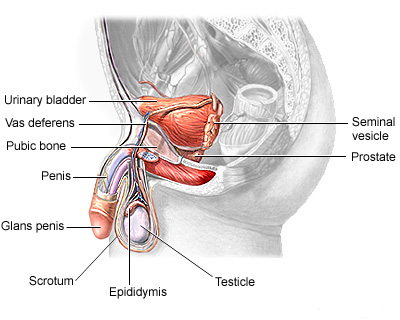
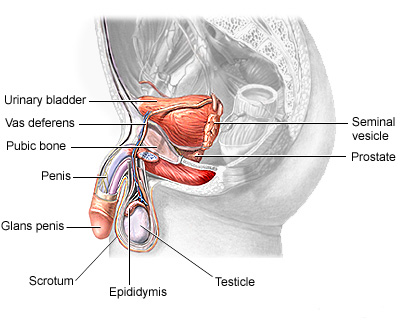
While testicular injuries can be from penetrating forces (e.g., stab wounds, gunshot wounds) or blunt forces (e.g., kick to the scrotum, baseball to the scrotum), they all have the potential of inflicting similar injuries: partial or complete ripping of the testicle as well as loss of the entire testicle. An injury sustained from a penetrating object such as a knife or bullet that punctures the scrotum, may cause a minor scrape to the skin or major injury to the blood vessels to the testicle itself. An injury can also be caused by a direct blow— such as a kick or baseball to the groin — causing a tear in the covering of the testicle or injury to its blood vessels.
While trauma to the testicle or scrotum usually produces severe pain as a first symptom, it can also result in actual physical injury to any of its contents. When the testicle's tough covering is torn or shattered , the blood leaks from the injury, stretching the normally elastic scrotum until it is tense. While this collection of blood can lead to infection, there also may be additional fertility problems due to the ultimate loss of a testicle or immune system problems that affect the remaining testicle. In severe cases of testicular injury, part or all of the injured testicle may need to be removed.
Considerable pain around the testicle may also be due to epididymitis, infection or inflammation of the epididymis. Because the epididymis, the lengthy coil alongside the testicle, is a very thin-walled gland it easily becomes red and swollen either by infection or injury. If left untreated, the condition rarely can lead to a loss of the testicle due to blockage of the blood supply to the testicle.
The symptoms mentioned above may indicate a very treatable, benign problem. But surprisingly, a substantial number of testicular tumors are discovered after minor injuries when men are more likely to carefully examine the testicles. Many men are not aware of the painless, solid lump, bulging from the smooth testicular covering until they have a reason to examine themselves. Do not make the mistake of many men who postpone medical care, thinking they are dealing with a simple bruise. This is a medical emergency! While testicular cancer caught early is generally curable, malignancies discovered late often require prolonged treatment involving surgery, radiation and chemotherapy.
Men who suffer more than a minor injury to the scrotum should seek an evaluation by a urologist. Reasons to seek medical care include:
A urologist can often determine the extent of injury to the testicle with a simple physical examination. After the urologist asks questions about how the injury occurred as well as other medical history questions, he or she will examine the contents of the scrotum. In doing so, the tough covering overlying the testicle can generally be easily felt as well as the narrow, soft epididymis. The structures that run into the testicle including the artery, vein and vas would then be felt to ensure that they are normal.
If everything appears normal, with no injury present, the urologist will probably prescribe pain medication such as acetaminophen or ibuprofen. A patient will also be advised to wear a jock strap, which provides good support for the scrotum.
If it unclear if an injury has occurred, the urologist may request a scrotal ultrasound scan. Based on the same sonar sound waves that guide submarines, this device can safely and effectively image parts of the sac, including the testicle, epididymis and spermatic cord to examine the blood flow.
Although no imaging test is 100 percent perfect, ultrasound is an attractive alternative because it is easy to perform, uses no X-rays and clearly shows the physical structure of the scrotum. On rare occasions, the urologists may request an MRI, a more sophisticated imaging technique, if the ultrasound leaves more questions than answers.
If any imaging study suggests testicular injury, the usual course of action is an operation where, under anesthesia, an incision is made in the scrotum and the entire contents are examined. If a tear of the testicle has occurred and the testicle can be repaired (if it has good blood supply and the remaining testicle has sufficient covering available), the urologist will usually repair the defect with stitches and then close the scrotum skin. In some cases, the urologist will leave a temporary plastic drain in the scrotum to drain blood and other fluids.
On occasion, an injury can be so severe that the testicle cannot be repaired. If this occurs, the urologist will remove the testicle. That does not mean the patient cannot father a child, however. If the patient's other testicle is normal, he should be able to impregnate his partner. Also, the patient's hormone levels should remain steady since only one testicle is required for either function
If the patient's physical examination and ultrasound suggest that the injury has caused epididymitis, he will probably be treated without surgery, given an anti-inflammatory medication (such as ibuprofen) and encouraged again to wear a jock strap. If necessary, the urologist may also prescribe an antibiotic. It generally takes six to eight weeks for the swelling to subside. The patient may have to have several follow-up visits with the urologist to chart his progress. Further, if conservative measures (medications and jock strap) do not work, surgery may be required and the testicle may have to be removed
Epididymitis is most common in young men ages 19 - 35. It is a major cause of hospital admissions in the military.
Epididymitis is usually caused by the spread of a bacterial infection from the urethra, prostate, or the bladder. The most common infections that cause this condition in young heterosexual men are gonorrhea andchlamydia. In children and older men,E. coli and similar infections are much more common. This is also true in homosexual men.
Mycobacterium tuberculosis (TB) can cause epididymitis. Other bacteria (such as Ureaplasma) may also cause the condition.
Another cause of epididymitis is the use of a medication called amiodarone, which prevents abnormal heart rhythms.
The following increase the risk for epididymitis:
Being uncircumcised
Recent surgery or a history of structural problems in the urinary tract
Epididymitis may begin with a low-grade fever, chills, and a heavy sensation in the testicle area. The area becomes more and more sensitive to pressure.
Physical examination shows a red, tender, and sometimes swollen lump (mass) on the affected side of the scrotum. Tenderness is usually in a small area of the testicle where the epididymis is attached.
There may be enlarged lymph nodes in the groin area (inguinal nodes), and a discharge from the penis. A rectal examination may show an enlarged or tender prostate.
Urinalysis and culture (you may need to give several specimens, including initial stream, mid-stream, and after a prostate massage)
Tests for chlamydia and gonorrhea
It is important to distinguish this condition from testicular torsion. Testicular torsion is an emergency and should be treated with surgery as soon as possible.
Your health care provider will prescribe medications to treat the infection. Sexually-transmitted infections require specific antibiotics. Your sexual partners should also be treated. You may need pain medications and anti-inflammatory medications.
The treatment for epididymitis caused by the medication amiodarone is a lower dose or change in the medication.
Bed rest, while elevating the scrotum and applying ice packs to the area, is recommended. It is very important to have a follow-up visit with your health care provider to find out whether the infection has gone away completely.
Epididymitis usually gets better with antibiotic treatment. There usually is no reduction in sexual or reproductive abilities. However, the condition may return.
If not treated, or in some other cases, the condition can become long-term (chronic). In chronic cases, there is usually no swelling, but there is pain.
Call your health care provider if you develop symptoms of epididymitis. Go to the emergency room or call the local emergency number if you have severe testicle pain suddenly or after an injury.
You can prevent complications from epididymitis by getting diagnosed early, and by treating any infections.
Your doctor may prescribe antibiotics before a surgery that increases the risk for epididymitis. Practicing safe sex (having intercourse with only one partner at a time, using condoms) may help prevent epididymitis caused by sexually-transmitted diseases.