Управление по санитарному надзору за качеством пищевых продуктов и медикаментов США одобрило к применению новое быстродействующее лекарственное средство против гриппа с инновационным механизмом действия.
Лактаза – лактозаны (сүт және сүт өнімдеріндегі қант) сіңіруге көмектесетің фермент.
Лактазаның жеткіліксіздігі ол сіздің организміңіз сүт өнімдерінің сіңіре алмайтындығын білдіреді.
Симптомдар
Лактозасы бар тағамдарды қабылдағаннан кейін, сізде асқазанда дискомфорт пайда болу мүмкін. Қосымша мынадай симптомдар болады:
Іш кебу
Диарея
Асқазанның шырышты қабатының қабынуы
Диагностика
Сізде лактоза көтере алмаушылықты тексеру үшін, дәрігер сізге қан және нәжісті тексеруге анализ тағайындайды.
Емі
Лактоза көтере алмауы ауыр дерт емес. Лактоза бар тағамдарды шектеу немесе лактоза сіңіруге көмектесетін препараттарды қабылдау сізге жеңілдік алып келеді. Мүмкін сізге кальций препараттары қажет болады, себебі сүт тағамдарын жеткілікті мөлшерде қабылдамаса, орагнизмде кальций мөлшері төмендейді. Себебі кальцийдің негізгі көзі – сүт тағамдары.
Аударған: Қартанбаев Бақберген Батырбекұлы
Бұл не? Ішектердің қабыну синдромы – екі негізгі ауруды қамтиды: спецификалық емес жаралы колит (тоқ ішекті зақымдайтын) және Крон ауруы (барлық бөлікке таралатын, көбінесе асқазан- ішек жолдарын зақымдайды; ауыз қуысынан сытққы өтіс тесігіне дейін).Айырмашылықтары – ішектің шырышты қабатында лимфоцитарлы гранулема-конгломерат табылады, бұл тек Крон ауруына тән.
Ішектің қабыну ауруларының симптомдары іш аймағындағы ауырсыну, жиі диарея – қан немесе ірің аралас, қалтырау, дене салмағының төмендеуі, шаршағыштық болып табылады.
Аурудың ағымы әлсіз немесе ауыр өтуі мүмкін және өршу немесе ремиссия (симптомсыз) фазаларында кездеседі. Крон ауруы мен жаралы колитпен ауыратын науқастарды ауруханаға жатқызуға тура келеді.
Емі аурудың ауырлық дәрежесіне және науқастың жасына байланысты жүргізіледі. Еміне мынадай дәр-дәрмектер қолданылады: кортикостероидтар, өндірістік аминосалицил қышқылы, дәрумендер, жоғарғы ақуызды диета. Ауыр жағдайда қан кетумен қабаттасады, сол кезде зақымдалған тоқ ішектің бөлігі операциялық жолмен алып тасталынады.
Аударған: Бердібек Ағабек
Лямблиоз (лямблиялар) – Giardialamblia, кейде Giardiaintestinalis аталатын паразиттік инфекциядан туындайтын ауру. Лямблиоз әдетте, паразитпен залалданған суды ішуден пайда болады.; G. lamblia көбінесе, өңделмеген бұлақтарда, өзен-көлдерде болады.
Лямблиоздың симптомдары – диарея, желдену, іштің түйіліп ауыруы және жүрек айнуы. Кейбір адамдарда лямблиоз ешқандай симптомдарды туындатпайды. Басқаларда симптомдар кейде ушығады.
Паразитті жұқтырудың алдын алу үшін: қолды жуу, және құбыр емес су көздерінен алған суды қолдану алдында немесе тамақ пісіруге, ыдыс жууға немесе тіс тазалауға қолдану алдында өңдеу қажет.
Лямблиоздың симптомдары өздігінше өтеді. Алайда, жайсыздықты басу және аурудың таралуының алдын алу үшін дәрі қолдану қажет (метронидазол).
Саяхатшылардың диареясы дегеніміз не?Саяхатшылардың диареясы – бұл әлемнің дамушы елдеріне саяхат шегетін дамыған елдердің адамдарына тән мәселе. Саяхатшылардың диареясының кейде айқын атаулары болады, мысалы: Монтезуманың кегі, Делийлік іш, Түрік іш өтуі.
Саяхатшылардың диареясының жоғары қауіпті аудандары – Африка, Азия, Таяу Шығыс, Латын Америкасының елдері. Төмен қауіпті елдер: Солтүстік Американың, Орталық Еуропа елдері, Австралия және Жапония.
Саяхатшылардың диареясының себебі неде? Саяхатшылардың диареясын әдетте, бактериалдық инфекция туындатады. Кең таралған себебі – бактериялар: ішек таяқшасы (E. coli), кампилобактер, шигеллалар, сальмонеллалар.
Әдетте, диареяны туындататын бактериялардың көздері – толық пісірілмеген немесе шикі тағам өнімдері, залалданған тағам өнімдері немесе су (оның ішінде, мұз кубиктері де).
Саяхатшылардың диареясының симптомдары қандай? Саяхатшылардың диареясы жеңілден күшті түрге дейін болады. көпшілік диареясы бар адамдарда бірінші екі аптада симптомдары пайда болады, көбінесе, дамушы елдердің аумағына келгеннен кейін 2-3 күн ішінде. Симптомдары:
· Іш өтуі.
· Іштің түйіліп ауырсынуы.
· Сусыздану, жеңілден күшті түрге дейін.
· Жалпы нашар сезіну, жүрек айнуы және құсу.
· Қалтырау, құсу және қан, сілемей аралас нәжіс. Бұл симптомдар диареяның ауыр түрін көрсетеді, бұл сусыздануға апарады. Сусызданудың кез келген қабылдайтын дәрінің әрекетіне әсер етуін ескеру қажет, мысалы, ішетін контрацептивтер немесе безгкекке қарсы дәрі-дәрмек.
Саяхатшылардың диареясын қалай емдеу қажет? Саяхатшылардың диареясын емдеу: сусызданудың алдын алу үшін сұйықтық тұтыну, пептобисмол және имодиум секілді дәрілерді қабылдау, ал кейде антибиотик қабылдау және көктамыр арқылы ерітінді енгізу қажет болады.
· Асқазанға тыныштық беру қажет. Бірнеше сағат бойы немесе жағдайыңыз жақсарғанға дейін тамақ ішпеңіз.
· Бөтелкедегі немесе қайнаған судан жиі шағын жұтыңыз; кепкен тұзды нанның шағын бөліктерін жеуге болады (қытырлақ нандар немесе крекерлер).
· Дүние жүзілік денсаулық сақтау ұйымы (ДДҰ) ұсынған тұзды ерітінді – регидронды ішіңіз. Мұндай тұзды ерітінділер көптеген дамушы елдердің дүкендері мен дәріханаларында болады. қайнаған немесе таза суда бір пачкесін ерітіңіз, тұз бен судың дұрыс қатынасына қатысты нұсқаулықпен міндетті түрде танысыңыз. Ерітіндіні 12 сағат бойы ішіңіз (бөлме температурасында сақталса), немесе 24 сағат бойы (егер тоңазытқышта сақталса).
· Қарапайым, аялайтын емдәм ұстаныңыз: қытырлақ нан, крекер, күріш, нан, картоп. Мұндай емдәм диареяның бәсеңдеуіне ықпал етеді. Диарея өткеннен кейін қайтадан әдеттегі тағамды тұтынуға болады.
2-жастағы немесе одан кіші балалар диареядан сусыздануға ерекше бейім келеді. Егер балаңызда диарея болса:
· Балаға регидрон ерітіндісін немесе Дүние жүзілік денсаулық сақтау ұйымы (ДДҰ) ұсынған ұқсас ерітінділерді, әдеттегі тамаққа қосымша ретінде беру қажет. Осындай тәртіпті балада диарея біткенге дейін жалғастыру қажет. Егер бала сұйықтықты жұта алмаса, ерітіндіні қасықпен беріп көріңіз.
· Егер емшек емізетін болсаңыз, әдеттегідей емізуді жалғастырыңыз. Жасанды қоректегі сәбилерге лактозасыз қоспаны немесе лактозаның мөлшері төмен қоспаны беру қажет.
· Балаға ботқа, йогурт, көкөністер мен жеміс беру қажет.
· Балада қан аралас іш өтуі, қызба немесе ұзақ құсу болса, дереу дәрігер шақырыңыз. Балаға регидратацияландыратын сұйықтық беруді жалғастырыңыз.
Диареядан дәрілер. пепто-бисмол және имодиум секілді дәрілер диареяны емдеуге көмектеседі. Егер аурудың басқа белгілері болмаса, мысалы, қызба, іштің түйіліп ауырсынуы, немесе жайсыздық, қан аралас нәжіс болмаса, осы дәрілерді қабылдаңыз. Егер қызба, қанды нәжіс немесе жүрек айнуы болса, антибиотиктер қабылдай бастау қажет. Дәрігермен кеңесу қажет.
Саяхатшылардың диареясының алдын алуда және емдеуде тиімділік көрсеткен висмут субсалицилаты (мысалы, Пепто-Бисмол). Висмут субсалицилаттары тіл мен нәжісті қара түске бояуы мүмкін. Оған мазасыздану қажет емес. Тіл қараймас үшін Висмут субсалицилаттарын қабылдағаннан кейін тіс пен тілді щеткамен тазалау қажет. Висмут субсалицилаттары безгектен қабылданатын дәрілердің тиімділігін төмендетуі мүмкін, ал аспиринге қарсы көрсетімдері бар адамдарға оны үш аптадан артық қабылдауға болмайды.
Лоперамид (мысалы, Имодиум) секілді препараттарды іш өтуінен қабылдауға болады бірақ, саяхатшылардың диареясынан қабылдауға болмайды, себебі, имодиум іш қатуын туындатуы мүмкін.
Есте ұстаңыз, диареядан болатын сусыздану басқа аурулардан қабылдайтын кез келген дәрінің тиімділігіне әсер етуі мүмкін. Егер қасыңызды 11 жастағы немесе одан кіші бала саяхаттап жүрсе, жолда қандай дәрі ішуге болатыны жайында дәрігерден сұраңыз.
Саяхатшылардың диареясының қалай алдын алуға болады? Диареяның алдын алудың оңтайлы тәсілі – залалданған су мен тағамды тұтынбау. Тағам туралы қолданыста жақсы ереже бар: ”егер тамақ қайнатылмаған, пісірілмеген немесе тазартылмаған болса, оны тұтынбаңыз». Шикі теңіз өнімдері және сүт өнімдерін тұтынуда бактериалдық зақымданудың қаупі жоғары. Құрғақ өнімдер, мысалы, нан, немесе өзіңіз тазартуға болатын жемістер, тұтынуда қауіпсіз.
Саяхат кезінде жергілікті суды ішуден алшақ болу қажет. Ішуге қауіпсіз сусындар:
· Шәй мен кофе, қайнаған суда демделген.
· Газдалған бөтелкедегі су немесе шәрбатты газдалған сусындар.
· Бөтелкедегі сыра мен шарап.
· Сондай-ақ, суды ішуге жарамды ету үшін оны сүзу және қайнату қажет.
Сонымен қатар, залалданған сумен жемістер-көкөністер, ыдыс жуылуы мүмкін екендігін, мұз кубиктарына қолданылу мүмкіндігін есте ұстау қажет. Өңделмеген сумен тісті тазалау да жұқпалану қаупін арттырады.
Сондай-ақ, көшедегі сауда-саттықтан алшақ болу қажет, онда шыбындар немесе нашар тазалық өнімдердің залалдану қаупін арттырады. Өнімдерді ашық базарларда сатып алған жағдайда оны тамаққа тұтыну алдында қайнатуды, пісіруді, тазартуды қамтамасыз ету қажет.
Қолды мұқият жуу инфекциялық ауруларды таратудың алдын алуда маңызды. Қолды тазартылған сумен жуу немесе спирттік салфеткамен/бактерияға қарсы гельмен өңдеу – инфекциялық аурудың қаупін азайтудың жақсы тәсілдері.
Дәрігерден саяхатқа диареядан қандай антибиотик алып шығу қажеттігін сұраңыз.
Irritable bowel syndrome (IBS) is a disorder that leads to abdominal pain and cramping, changes in bowel movements, and other symptoms.
IBS is not the same as inflammatory bowel disease (IBD), which includes Crohn's disease and ulcerative colitis. In IBS, the structure of the bowel is not abnormal.
CAUSES
It is not clear why patients develop IBS. Sometimes it occurs after an infection of the intestines. This is called postinfectious IBS. There may also be other triggers.
The intestine is connected to the brain. Signals go back and forth between the bowel and brain. These signals affect bowel function and symptoms. The nerves can become more active during stress, causing the intestines to be more sensitive and squeeze (contract) more.
IBS can occur at any age, but it often begins in the teen years or early adulthood. It is twice as common in women as in men.
IBS is the most common intestinal problem that causes patients to be referred to a bowel specialist (gastroenterologist).
SYMPTOMS
Symptoms range from mild to severe. Most people have mild symptoms. Symptoms are different from person to person.
The main symptoms of IBS are abdominal pain, fullness, gas, and bloating that have been present for at least 3 days a month for the last 3 months. The pain and other symptoms will often:
Be reduced or go away after a bowel movement
Occur when there is a change in how often you have bowel movements
People with IBS may switch between constipation and diarrhea, or mostly have one or the other.
People with diarrhea will have frequent, loose, watery stools. They will often have an urgent need to have a bowel movement, which may be hard to control.
Those with constipation will have a hard time passing stool, as well as fewer bowel movements. They will often need to strain and will feel cramps with a bowel movement. Often, they do not release any stool, or only a small amount.
For some people, the symptoms may get worse for a few weeks or a month, and then decrease for a while. For other people, symptoms are present most of the time.
People with IBS may also lose their appetite.
EXAMS AND TESTS
There is no test to diagnose IBS. Tests may be done to rule out other problems:
Blood tests to see if you have celiac disease or a low blood count (anemia)
Stool cultures to check for an infection
Some patients will have a colonoscopy. During this test, a flexible tube is inserted through the anus to examine the colon. You may need this test if:
Symptoms began later in life (over age 50)
You have symptoms such as weight loss or bloody stools
You have abnormal blood tests (such as a low blood count)
Other disorders that can cause similar symptoms include:
Celiac disease
Colon cancer (cancer rarely causes typical IBS symptoms, unless symptoms such as weight loss, blood in the stools, or abnormal blood tests are also present)
Lifestyle changes can help in some cases of IBS. For example, regular exercise and improved sleep habits may reduce anxiety and help relieve bowel symptoms.
Dietary changes can be helpful. However, no specific diet can be recommended for IBS, because the condition differs from one person to another.
The following changes may help:
Avoid foods and drinks that stimulate the intestines (such as caffeine, tea, or colas)
Avoid large meals
Increase fiber in the diet (this may improve constipation but make bloating worse)
Talk with your doctor before taking over-the-counter medications.
No one medication will work for everyone. Medications your doctor might try include:
Anticholinergic medications (dicyclomine, propantheline, belladonna, and hyoscyamine) taken about a half-hour before eating to control intestinal muscle spasms
Bisacodyl to treat constipation
Loperamide to treat diarrhea
Low doses of tricyclic antidepressants to help relieve intestinal pain
Lubiprostone for constipation symptoms
Rifaximin, an antibiotic
Therapy may help in cases of severe anxiety or depression.
PROGNOSIS
Irritable bowel syndrome may be a lifelong condition. For some people, symptoms are disabling and reduce the ability to work, travel, and attend social events.
Symptoms can often be improved or relieved through treatment.
IBS does not cause permanent harm to the intestines, and it does not lead to a serious disease, such as cancer.
Dehydration means your body does not have as much water and fluids as it should.
Dehydration can be mild, moderate, or severe based on how much of the body's fluid is lost or not replenished. When it is severe, dehydration is a life-threatening emergency.
Dehydration in sick children is often a combination of refusing to eat or drink anything and losing fluid from vomiting, diarrhea, or fever.
Infants and children are more likely to become dehydrated than adults because they weigh less and their bodies turn over water and electrolytes more quickly. The elderly and people with illnesses are also at higher risk.
You may also have vomiting, diarrhea, or the feeling that you "can't keep anything down." All of these can be causing the dehydration.
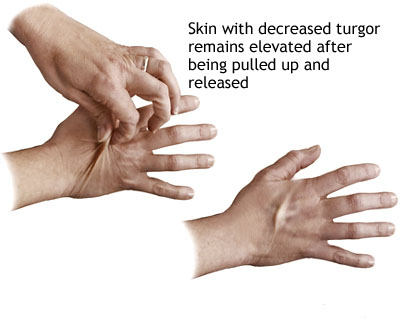
A decrease in skin turgor is indicated when the skin (on the back of the hand for an adult or on the abdomen for a child) is pulled up for a few seconds and does not return to its original state. A decrease in skin turgor is a late sign of dehydration.
Poor skin turgor -- the skin may not be as elastic as normal and sag back into position slowly when the health care provider pinches it up into a fold (normally, skin springs right back into place)
Drinking fluids is usually enough for mild dehydration. It is better to drink small amounts of fluid often (using a teaspoon or syringe for an infant or child), instead of trying to force large amounts of fluid at one time. Drinking too much fluid at once can bring on more vomiting.
Electrolyte solutions or freezer pops are very effective. These are available at pharmacies. Sports drinks contain a lot of sugar and can cause or worsen diarrhea. In infants and children, avoid using water as the primary replacement fluid.
Intravenous fluids and a hospital stay may be needed for moderate to severe dehydration. The health care provider will try to identify and then treat the cause of the dehydration.
Most cases of stomach viruses (also called viral gastroenteritis) tend to get better on their own after a few days. See also: Diarrhea
Even when you are healthy, drink plenty of fluids every day. Drink more when the weather is hot or you are exercising.
Carefully monitor someone who is ill, especially an infant, child, or older adult. If you believe that the person is getting dehydrated, call your health care provider before the person becomes dehydrated. Begin fluid replacement as soon as vomiting and diarrhea start -- DO NOT wait for signs of dehydration.
Always encourage a person who is sick to drink fluids. Remember that fluid needs are greater with a fever, vomiting, or diarrhea. The easiest signs to monitor are urine output (there should be frequent wet diapers or trips to the bathroom), saliva in the mouth, and tears when crying.
What is traveler's diarrhea?
People get traveler's diarrhea by eating food and drinking water that contain germs. People can get this illness in areas of the world where the drinking water is not clean.
People who live these areas often drink tap water that contains these germs, but they do not get diarrhea. This is because their bodies are used to the germs. In the same way, cooks and food handlers may have the germs that cause traveler's diarrhea on their hands, but they may not get sick themselves. When people travel to a new place, they are more likely to become sick, because they lack protective antibodies (infection-fighting agents in the blood) that attack these germs.
How can I tell if I have traveler's diarrhea?
You may have traveler's diarrhea if you have at least 3 loose stools in 24 hours. You may also have one or more of the following symptoms:
Even if you don't treat traveler's diarrhea, it will usually go away in 4 to 5 days. You should drink plenty of clear liquids to replace lost fluids due to the diarrhea. Taking medicine to treat traveler's diarrhea may make you feel better more quickly. It often is treated with antibiotics (medicines that kill bacteria). To get antibiotics, you need a prescription from your doctor.
You also can take a medicine called loperamide (brand name: Imodium). However, if you have bloody diarrhea, you should not take this medicine without also taking an antibiotic.
Children, pregnant women, older adults and other people who get dehydrated easily should drink rehydration solutions. Rehydration solutions help replace the fluid you lose while you are sick. You can buy packets of rehydration salts (to be mixed with safe water) at camping/outdoor stores or drug stores.
When should I contact my doctor?
If your child has a fever higher than 102°F, is dehydrated, has blood in the stool or vomits several times, he or she should see a doctor right away.
If treating your traveler's diarrhea isn't helping you to feel better, talk to your doctor.
How can I avoid traveler's diarrhea?
When you will be traveling to an area where the water may not be clean, see your doctor 4 to 6 weeks before your trip. Your doctor may want to give you some medicines, such as antibiotics or shots, to protect you from illness while you are away. During your trip, be careful about the following things:
Do not drink tap water and do not use it to brush your teeth.
Do not drink bottled water if the seal on the bottle has been broken.
Do not use ice unless you're sure it's made from purified water.
Do not drink milk or eat dairy products that have not been pasteurized (heated to a temperature that kills all germs).
Do not eat raw fruits or vegetables unless they can be peeled and you are the one who peels them.
Do not eat cut-up fruit salad.
Do not eat lettuce or other leafy raw vegetables (such as spinach).
Do not eat raw or rare (slightly cooked) meat or fish.
Do not eat food from people who sell it on the street.
Boiling water will kill the germs that cause diarrhea, making the water safe to drink. Boil water vigorously for 1 minute and allow it to cool to room temperature (do not add ice). When traveling in high altitudes (6,562 feet or higher), boil water for 3 minutes.
What is safe to eat or drink?
When you are in a place where you could get traveler's diarrhea, it is probably safe to eat or drink the following:
Soft drinks that are carbonated (such as cola).
Hot drinks, such as tea or coffee.
Carbonated or noncarbonated bottled water, as long as you are the one who breaks the seal on the bottle.
Raw fruits or vegetables that can be peeled, as long as you are the one who peels them.
Food that is served hot.
Meat that is well cooked.
Questions to Ask Your Doctor
Is there medicine I can take to prevent traveler’s diarrhea?
Is traveler’s diarrhea common in the country I’m traveling to?
If I get traveler’s diarrhea, who should I contact and when?
Babies' bodies make the lactase enzyme so they can digest milk, including breast milk.
· Babies born too early (premature) sometimes have lactose intolerance.
· Children who were born at full term often do not show signs of the problem before they are 3 years old.
Lactose intolerance is very common in adults. It is rarely dangerous. About 30 million American adults have some degree of lactose intolerance by age 20.
· In white people, lactose intolerance often develops in children older than age 5. This is the age when our bodies may stop making lactase.
· In African Americans, the problem can occur as early as age 2.
· The condition is very common among adults with Asian, African, or Native American heritage.
· It is less common in people of northern or western European background, but still may occur.
An illness that involves or injures your small intestine may cause less of the lactase enzyme to be made. Treatment of these illnesses may improve the symptoms of lactose intolerance. These may include:
· Surgery of the small intestine
· Infections in the small intestine (this is most often seen in children)
Cutting down your intake of milk products that contain lactose from your diet most often eases symptoms. Also look at food labels for hidden sources of lactose in nonmilk products (including some beers) and avoid these.
Most people with low lactase level can drink up to one half cup of milk at one time (2 to 4 ounces or 60 to 120 milliliters) without having symptoms. Larger servings (more than 8 ounces or 240 mL) may cause problems for people with the deficiency.
Milk products that may be easier to digest include:
· Buttermilk and cheeses (these foods contain less lactose than milk)
· Fermented milk products, such as yogurt
· Goat's milk
· Ice cream, milkshakes, and aged or hard cheeses
· Lactose-free milk and milk products
· Lactase-treated cow's milk for older children and adults
· Soy formulas for infants younger than 2 years
· Soy or rice milk for toddlers
You can add lactase enzymes to regular milk. You can also take these enzymes as capsules or chewable tablets. There are also many lactose-free dairy products available.
Not having milk and other dairy products in your diet can lead to a shortage of calcium, vitamin D, riboflavin, and protein. You need 1,000 to 1,500 mg of calcium each day depending on your age and gender. Some things you can do to get more calcium in your diet are:
· Take calcium supplements with Vitamin D. Talk to your health care provider about which ones to choose.
· Eat foods that have more calcium (such as leafy greens, oysters, sardines, canned salmon, shrimp, and broccoli).
Symptoms most often go away when you remove milk, other dairy products, and other sources of lactose from your diet. Without dietary changes, infants or children may have growth problems.
Gastroenteritis is an infection that causes vomiting and diarrhea.
Gastroenteritis can be due to an infection with a virus, bacteria, or parasites. Also called the "stomach flu," it is contagious and spreads easily in childcare and schools. It often also causes fever.
Stool samples might be tested for bacteria or parasites if there is blood in the stool. Antibiotics are usually not needed except for certain types of infections in young infants and in people with immune problems.
Gastroenteritis usually is not serious and generally lasts a few days. The greatest risk from gastroenteritis is dehydration, so it's most important to stay hydrated with plenty of fluids. Young kids are at the highest risk for dehydration.