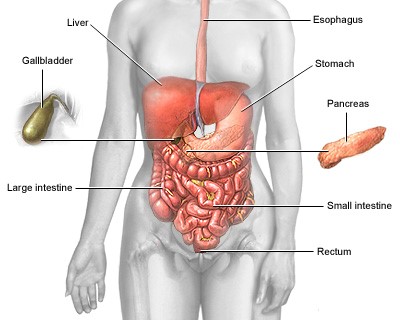
Irritable bowel syndrome (IBS) is a disorder that leads to abdominal pain and cramping, changes in bowel movements, and other symptoms.
IBS is not the same as inflammatory bowel disease (IBD), which includes Crohn's disease and ulcerative colitis. In IBS, the structure of the bowel is not abnormal.
CAUSES
It is not clear why patients develop IBS. Sometimes it occurs after an infection of the intestines. This is called postinfectious IBS. There may also be other triggers.
The intestine is connected to the brain. Signals go back and forth between the bowel and brain. These signals affect bowel function and symptoms. The nerves can become more active during stress, causing the intestines to be more sensitive and squeeze (contract) more.
IBS can occur at any age, but it often begins in the teen years or early adulthood. It is twice as common in women as in men.
IBS is the most common intestinal problem that causes patients to be referred to a bowel specialist (gastroenterologist).
SYMPTOMS
Symptoms range from mild to severe. Most people have mild symptoms. Symptoms are different from person to person.
The main symptoms of IBS are abdominal pain, fullness, gas, and bloating that have been present for at least 3 days a month for the last 3 months. The pain and other symptoms will often:
Be reduced or go away after a bowel movement
Occur when there is a change in how often you have bowel movements
People with IBS may switch between constipation and diarrhea, or mostly have one or the other.
People with diarrhea will have frequent, loose, watery stools. They will often have an urgent need to have a bowel movement, which may be hard to control.
Those with constipation will have a hard time passing stool, as well as fewer bowel movements. They will often need to strain and will feel cramps with a bowel movement. Often, they do not release any stool, or only a small amount.
For some people, the symptoms may get worse for a few weeks or a month, and then decrease for a while. For other people, symptoms are present most of the time.
People with IBS may also lose their appetite.
EXAMS AND TESTS
There is no test to diagnose IBS. Tests may be done to rule out other problems:
Blood tests to see if you have celiac disease or a low blood count (anemia)
Stool cultures to check for an infection
Some patients will have a colonoscopy. During this test, a flexible tube is inserted through the anus to examine the colon. You may need this test if:
Symptoms began later in life (over age 50)
You have symptoms such as weight loss or bloody stools
You have abnormal blood tests (such as a low blood count)
Other disorders that can cause similar symptoms include:
Celiac disease
Colon cancer (cancer rarely causes typical IBS symptoms, unless symptoms such as weight loss, blood in the stools, or abnormal blood tests are also present)
Lifestyle changes can help in some cases of IBS. For example, regular exercise and improved sleep habits may reduce anxiety and help relieve bowel symptoms.
Dietary changes can be helpful. However, no specific diet can be recommended for IBS, because the condition differs from one person to another.
The following changes may help:
Avoid foods and drinks that stimulate the intestines (such as caffeine, tea, or colas)
Avoid large meals
Increase fiber in the diet (this may improve constipation but make bloating worse)
Talk with your doctor before taking over-the-counter medications.
No one medication will work for everyone. Medications your doctor might try include:
Anticholinergic medications (dicyclomine, propantheline, belladonna, and hyoscyamine) taken about a half-hour before eating to control intestinal muscle spasms
Bisacodyl to treat constipation
Loperamide to treat diarrhea
Low doses of tricyclic antidepressants to help relieve intestinal pain
Lubiprostone for constipation symptoms
Rifaximin, an antibiotic
Therapy may help in cases of severe anxiety or depression.
PROGNOSIS
Irritable bowel syndrome may be a lifelong condition. For some people, symptoms are disabling and reduce the ability to work, travel, and attend social events.
Symptoms can often be improved or relieved through treatment.
IBS does not cause permanent harm to the intestines, and it does not lead to a serious disease, such as cancer.
Что это такое?Синдром воспаленной кишки включает два основных заболевания: неспецифический язвенный колит, который поражает толстую кишку, и Болезнь Крона, которая распространяется любую часть всего пищеварительного тракта, начиная от рта и заканчивая анусом. Другим отличающим фактором является нахождение так называемых гранулем – конгломерата лимфоцитов в слизистой оболочке кишки, характерных для Болезни Крона.
Симптомы воспалительной болезни кишечника могут включать боль в области живота, частую диарею, с примесью крови или гноя, озноб, снижение веса и утомляемость. Болезнь может быть слабой или тяжелой и протекает с периодами обострения и с отсутствием симптомов (ремиссия). Людей, страдающих болезнью Крона и язвенным колитом, часто приходится госпитализировать.
Лечение зависит от степени тяжести приступов и возраста больного. Лечение может включать лекарства, такие как кортикостероиды и производные аминосалициловой кислоты, витамины, высокобелковые диеты. В серьезных случаях, сопровождающихся кровотечением, приходится делать операции по удалению сегментов толстой кишки.