Repetitive motion injuries are among the most common injuries in the United States. All of these disorders are made worse by the repetitive actions of daily living.
Repetitive motion injuries make up over 50% of all athletic-related injuries seen by doctors and result in huge losses in terms of cost to the workforce. Simple everyday actions, such as throwing a ball, scrubbing a floor, or jogging, can lead to this condition.
The most common types of repetitive motion injuries are tendinitis and bursitis. These two disorders are difficult to differentiate and many times may coexist.
Tendinitis
A tendon is a white fibrous tissue that connects muscle to bone and allows for movement at all joints throughout the human body. Because tendons must be able to bear all of the weight of the attached muscle, they are very strong.
Tendinitis is an inflammation of the tendon. (Whenever you see "-itis" at the end of a word, think "inflammation.")
Males are slightly more likely to have this disorder.
The inflammation of the tendon usually occurs at the site of insertion into bone.
Tendons run through a lubricating sheath where they connect into muscle, and this sheath also may become inflamed. This condition is known as tenosynovitis.
Tenosynovitis is almost identical to tendinitis because both have identical causes, symptoms, and treatment.
Tenosynovitis of the wrist may be involved in carpal tunnel syndrome, the most common compression nerve disorder, but this cause-and-effect relationship has never been proven.
Bursitis
A bursa is a small pouch or sac that is found over an area where friction may develop and serves to cushion or lubricate the area between tendon and bone.
Bursitis is inflammation of a bursa sac.
Over 150 bursae are in the body.
Most bursae are present at birth, but some come into existence in sites of repetitive pressure.
Common areas where bursitis can occur include the elbow, knee, and hip.
Different types of bursitis include traumatic, infectious, and gouty.
Traumatic bursitis is the type involved with repetitive motion injuries.
Traumatic bursitis is most common in people younger than 35 years.
Repetitive motion disorders develop because of microscopic tears in the tissue. When the body is unable to repair the tears in the tissue as fast as they are being made, inflammation occurs, leading to the sensation of pain. Causes of repetitive motion injuries include:
Tendinitis: The most common symptom associated with tendinitis is pain over the site involved. Tendinitis is made worse by active motion of the inflamed tendon. The skin overlying the inflamed tendon may be red and warm to the touch.
Biceps: The painful spot is usually in the groove where the arm meets the shoulder. You can reproduce the pain by flexing your elbow at 90 and trying to turn your hand palm up (called supination) against resistance.
Tennis elbow: This pain is in the elbow and is reproduced by cocking your wrist back (extending the wrist) as if you are bringing a tennis racket back to hit the ball.
Golfer's elbow: This pain also occurs in the elbow but is made worse by flexing the wrist forward as if you are hitting a golf ball.
Rotator cuff: Raising your arm out to the side reproduces this pain. The painful area is usually over the affected shoulder.
Bursitis: Common symptoms include pain, tenderness, and decreased range of motion over affected area. Redness, swelling, and a crunchy feeling when the joint is moved (crepitus) may also occur.
Knee: This condition involves swelling over the bottom part of the kneecap that is red and warm to the touch. Usually, the range of motion of the knee will be less because of the pain that bending and straightening the knee causes.
Elbow: Pain, swelling, and redness are found over the elbow. The pain gets worse when you flex and extend your arm at the elbow.
Hip: Your pain is increased by walking or by lying on the affected side. Bringing your leg away from and toward the midline of the body can also reproduce the pain.
When to call the doctor Call your doctor if you have any of the following symptoms:
Pain with movement of arms and legs
Tenderness over a joint or where a tendon connects
Redness and increased warmth over a joint
Pain that wakes you from sleep
Inability to sleep on affected side
Inability to carry on normal activities of daily living (such as brushing your teeth or taking a shower)
When to go to the hospital
Certain signs and symptoms may mean that you have an infection and should be seen by a doctor immediately. Seek immediate medical care for any of the following symptoms:
The diagnosis of tendinitis is most often made based on history and a physical examination.
Imaging studies may help confirm the diagnosis. The imaging study of choice is the MRI. An MRI gives a very detailed picture and can identify a tear, rupture, inflammation, or other disease processes. An MRI is not useful in visualizing inflammation of the tendon sheath, tenosynovitis, unless fluid is present within the sheath itself.
Bursitis
Your doctor will check if your bursitis has an inflammatory or an infectious cause. The elbow and knee have a higher risk of having an infectious cause, so fluid will probably be drained from your joint to be checked for bacterial infection.
Conditions that place you at a higher risk for infectious bursitis include:
Home care for a painful or swollen joint should include elevation and not moving it until your doctor can be contacted. You can also use ice for relief of pain and swelling.
Most authorities recommend icing 2-3 times a day for 20-30 minutes each time.
Wrap ice or a bag of frozen vegetables in a towel and place it on the area.
If your shoulder is involved, you should not keep it immobile for more than 24-48 hours because your shoulder may become frozen and have decreased range of motion.
Tendinitis is best treated with immobilization and ice during the early phase and moist heat during the long-term phase.
Bands placed around the elbow may be used for tennis elbow and golfer's elbow.
Nonsteroidal anti-inflammatory drugs (NSAIDs, such as aspirin, naproxen, or ibuprofen) may be prescribed to reduce the inflammation. All NSAIDs should be taken with food or milk to avoid stomach upset.
If your tendinitis or bursitis is not helped by NSAIDs, the doctor may choose to inject steroids into the surrounding area of inflammation. As a rule, you should not have more than 3 injections into the same area within a 12-month period.
You should begin graduated range-of-motion exercise once your symptoms begin to improve.
An exception to this type of treatment is shoulder involvement.
The shoulder should not be immobilized for more than 24-48 hours in order to minimize frozen shoulder, called adhesive capsulitis.
You should have physical therapy in addition to ultrasound and warm water baths.
The goal in treatment of shoulder tendinitis is first and foremost to maintain full range of motion of the shoulder joint. Relieving the symptoms is secondary.
The treatment of inflammatory bursitis is similar to that of tendinitis.
Use rest and ice, and elevate your arm or leg.
Alternative treatments include pain-killing creams, capsaicin cream (an over-the-counter pain relief cream made from an ingredient of cayenne pepper), and steroid medications if you are able to take them.
If your bursitis is caused by an infection, treatment will include the appropriate antibiotics.
Steroid injection may be used but only for inflammatory bursitis. Steroid injections should be avoided in infectious bursitis because they may increase the body's susceptibility to infection.
The prevention of tendinitis and bursitis is similar in most respects.
Do adequate warm-up and cool-down maneuvers (crucial to proper tendon and bursae health).
Avoid activity that makes your injury flare up. This will speed healing of both tendinitis and bursitis.
If using a hedge clipper caused you pain, avoid this activity and others like it.
If reaching overhead in your work has caused a repetitive motion injury, your occupational health manager may be able to redesign your job so you won't have to reach overhead.
Practice range-of-motion exercises, especially with tendinitis. These are important to ensure minimal decrease in function.
Use splints or bands to decrease the strain on a tendon that occurs with sporting activities, such as tennis and golf. These devices may be bought over-the-counter or obtained from your doctor.
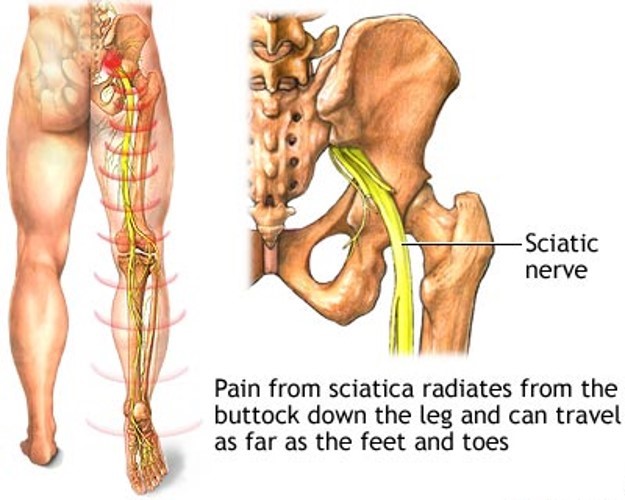
Sciatica refers to pain, weakness, numbness, or tingling in the leg. It is caused by injury to or pressure on the sciatic nerve. Sciatica is a symptom of another medical problem. It is not a medical condition on its own.
Sciatica occurs when there is pressure or damage to the sciatic nerve. This nerve starts in the lower back and runs down the back of each leg. This nerve controls the muscles of the back of the knee and lower leg. It also provides sensation to the back of the thigh, part of the lower leg, and the sole of the foot.
Sciatica pain can vary widely. It may feel like a mild tingling, dull ache, or burning sensation. In some cases, the pain is severe enough to make a person unable to move.
The pain most often occurs on one side. Some people have sharp pain in one part of the leg or hip and numbness in other parts. The pain or numbness may also be felt on the back of the calf or on the sole of the foot. The affected leg may feel weak. Sometimes, your foot gets caught on the ground when walking.
The pain often starts slowly. It may get worse:
· After standing or sitting
· At night
· When sneezing, coughing, or laughing
· When bending backward or walking more than a few yards, especially if caused by spinal stenosis
Because sciatica is a symptom of another medical condition, the underlying cause should be identified and treated.
In some cases, no treatment is required and recovery occurs on its own.
Conservative (non-surgical) treatment is best in many cases. Your doctor may recommend the following steps to calm your symptoms and reduce inflammation:
· Apply heat or ice to the painful area. Try ice for the first 48 to 72 hours, then use heat.
· Take over-the-counter pain relievers such as ibuprofen (Advil, Motrin IB) or acetaminophen (Tylenol).
· Reduce your activity for the first couple of days. Then, slowly start your usual activities.
· Do not do heavy lifting or twisting of your back for the first 6 weeks after the pain begins.
· Start exercising again after 2 to 3 weeks. Include exercises to strengthen your abdomen and improve flexibility of your spine.
Physical therapy may also be recommended. Additional treatments depend on the condition that is causing the sciatica.
If these measures do not help, your doctor may recommend injections of certain medicines to reduce swelling around the nerve. Other medicines may be prescribed to help reduce the stabbing pains due to nerve irritation.
Nerve pain is very difficult to treat. If you have ongoing problems with pain, you may want to see a neurologist or a pain specialist to ensure that you have access to the widest range of treatment options.
More serious complications depend on the cause of sciatica, such as slipped disc or spinal stenosis. Sciatica can lead to permanent numbness or weakness of your leg.
Синдром повторительного движения – это термин, используемый для описания таких симптомов как боль, отек или чувствительность, которые появляются при многократном повторении одного и того же движения. Специалисты не согласны с использованием этого термина в качестве диагноза.
Повторение одного и того же действия может вызвать отек и износ ткани.
Причиной возникновения синдрома повторительного движения может быть и работа, и активный отдых.
Когда ткань отекает и оказывает давление на нервы, может появиться:
чувствительность
покалывание
онемение
слабость
боль при использовании
Лечение синдрома повторительного движения включает:
Отказ от деятельности вызывающей симптомы.
Упражнения на растяжку и силовые упражнения.
Поочередное прикладывание холодного и горячего компресса.
Покой и использование шин.
Использование противовоспалительных лекарственных препаратов.
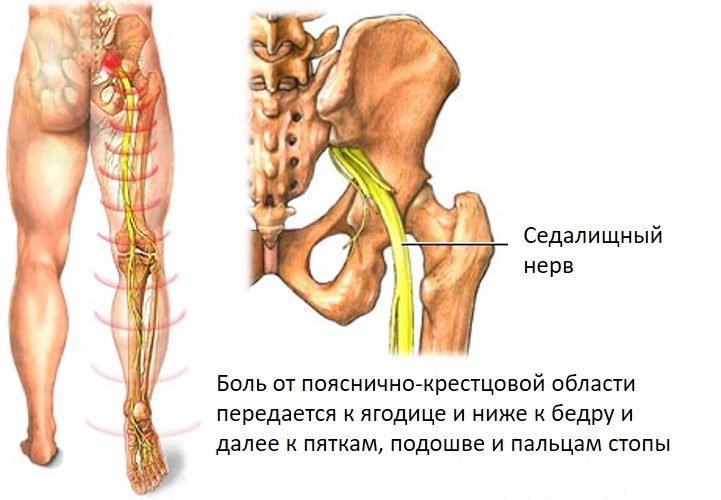
Ишиаз проявляется болью, слабостью, чувством онемения и покалывания в ноге. Данное состояние обусловлено травмой или сдавливанием седалищного нерва. Ишиаз не является самостоятельным заболеванием, это лишь симптом какого-либо другого заболевания.
Ишиаз возникает при травме или сдавлении седалищного нерва. Этот нерв берет начало в области поясницы и спускается вниз по задней поверхности каждой ноги. Этот нерв управляет работой мышц задней поверхности колена и голени. Он также обеспечивает чувствительность в области задней поверхности бедра, части голени и подошвенной поверхности стопы.
К наиболее распространенным причинам ишиаза относятся:
· Грыжа межпозвоночного диска
· Стеноз позвоночного канала
· Синдром грушевидной мышцы (болевое ощущение в области ягодицы)
Седалищная боль может варьировать. Она может ощущаться как легкое покалывание, тупая боль или чувство жжения. В некоторых случаях боль настолько сильная, что способна ограничить подвижность.
В большинстве случаев боль односторонняя. Некоторые лица могут испытывать острую боль в одной части ноги или бедра и чувство онемения на других участках. Боль и онемения также могут ощущаться в области задней поверхности голени и подошвенной поверхности стопы. В пораженной конечности может ощущаться слабость. Иногда при ходьбе вам может быть сложно оторвать стопу от земли.
Обычно боль начинается медленно. Она может прогрессировать:
· После того, как вы встали или сели
· По ночам
· После чихания, кашля или смеха
· При наклоне назад или длительной ходьбе пешком, особенно если это обусловлено стенозом позвоночного канала
Так как ишиаз является симптомом других заболеваний, необходимо выявить основное заболевание.
В некоторых случаях лечение не требуется, выздоровление наступает само по себе.
Во многих случаях хороши консервативные (не хирургические) методы лечения. Врач может дать вам следующие советы, чтобы облегчить ваши симптомы и уменьшить воспаление:
· Приложите тепло или лед на пораженную область. В течение первых 48-72 часов предпочтителен лед, позднее – тепло.
· Примите обезболивающий препарат, такой как ибупрофен или ацетаминофен
Мероприятия по уходу за своей спиной в домашних условиях:
· Постельный режим не рекомендуется
· В течение первых двух дней следует ограничить свою двигательную активность. Затем, постепенно возвращайтесь к своей повседневной активности.
· Не следует поднимать тяжести или делать упражнения по скручиванию спины в течение первых 6 недель после начала болей.
· Начинать физические упражнения следует через 2-3 недели. Включите упражнения для укрепления брюшной стенки и улучшения гибкости позвоночника
Также может быть рекомендована физиотерапия. Дополнительные методы лечения могут быть назначены в зависимости от причины, вызвавшей ишиаз.
Если данные меры не эффективны, врач может назначить вам инъекции препаратов для уменьшения воспаления вокруг нерва. Другие лекарственные препараты могут быть назначены для облегчения колющей боли, вызванной раздражением нерва.
Боль при поражении нервов очень сложно лечить. Если вас беспокоят постоянные боли, вы можете обратиться к невропатологу или специалисту по боли, чтобы быть уверенным в том, что у вас есть доступ к самым разнообразным методам лечения.
Более серьезные осложнения зависят от причины развития ишиаза, таких как, грыжа межпозвоночного диска или стеноз позвоночного канала. Ишиаз может привести к постоянному чувству онемения или слабости в ноге.
Меры профилактики варьируют в зависимости от причины, вызвавшей поражение нерва. Старайтесь избегать длительного нахождения в положении сидя и лежа со сдавливанием нервов в области ягодиц