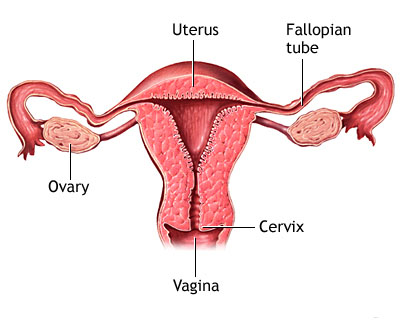
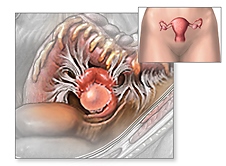
An ovarian cyst is a fluid-filled sac in or on the ovary. There are several types of ovarian cysts. Many ovarian cysts are noncancerous cysts that occur as a result of ovulation (the release of an egg from the ovary). These are called functional cysts.
Often functional cysts do not cause any symptoms (you may not even know you have one), but other times they can cause abdominal pain, bloating, menstrual irregularities, nausea and vomiting. Other symptoms include feeling full after eating just a little and constipation.
If you are menopausal and are not having periods, you shouldn't form functional cysts, but it is possible for you to form other types of ovarian cysts. You should call your doctor if you experience any of the symptoms of an ovarian cyst.
Often times, your doctor will feel a cyst during your physical exam. If you do have a cyst, your doctor will probably want you to have a sonogram so he or she can look at the cyst. What your doctor decides to do after that depends on your age, the way the cyst looks on the sonogram and if you're having symptoms.
A sonogram uses sound waves to make pictures of organs in the body. It's a good way for your doctor to look at your ovaries. This kind of sonogram can be done either through your abdomen or your vagina. Neither type is painful. The sonogram usually lasts about 30 minutes. It will give your doctor valuable information about the size and the appearance of your cyst.
Your doctor might test the level of a protein called CA-125 in your blood. Sometimes this blood test is done in women who have an ovarian cyst to see if their cyst could be cancerous. A normal CA-125 level is less than 35. However, this test is not always an accurate way to tell if a woman has ovarian cancer. For example, some women who do have ovarian cancer have a normal CA-125 level. Also, this level can sometimes be high in women who do not have cancer, particularly if they are in their childbearing years. For these reasons, the CA-125 blood test is only recommended for women who show signs or symptoms of ovarian cancer or who have genetic mutations that increase the risk of ovarian cancer.
Functional cysts normally shrink on their own over time, usually in about 1 to 3 months. If you have a functional cyst, your doctor may want to check you again in 1 to 3 months to make sure the cyst has gotten smaller. If you develop functional cysts often, your doctor may want you to take birth control pills so you won't ovulate. If you don't ovulate, you won't form functional cysts.
The treatment for ovarian cysts depends on several things, such as your age, whether you are having periods, the size of the cyst, its appearance and your symptoms.
If you're having periods, only mild symptoms and the cyst is functional, you probably won't need to have surgery. If the cyst doesn't go away after several menstrual periods, if it gets larger or if it doesn't look like a functional cyst on the sonogram, your doctor may want you to have an operation to remove it. There are many different types of ovarian cysts in women of childbearing age that do require surgery. Fortunately, cysts in women of this age are almost always benign (noncancerous).
If you're past menopause and have an ovarian cyst, your doctor will probably want you to have surgery. Ovarian cancer is rare, but women 50 to 70 years of age are at greater risk. Women who are diagnosed at an early stage do much better than women who are diagnosed later.
If the cyst is small (about the size of a plum or smaller) and if it looks benign on the sonogram, your doctor may decide to do a laparoscopy. This type of surgery is done with a lighted instrument called a laparoscope that's like a slender telescope. This is put into your abdomen through a small incision (cut) just above or just below your navel (belly button). With the laparoscope, your doctor can see your organs. Often the cyst can be removed through small incisions at the pubic hair line.
If the cyst looks too big to remove with the laparoscope or if it looks suspicious in any way, your doctor will probably do a laparotomy. A laparotomy uses a bigger incision to remove the cyst or possibly the entire affected ovary and fallopian tube. While you are under general anesthesia (which puts you in a sleep-like state) the cyst can be tested to find out if it is cancer. If it is cancer, your doctor may need to remove both of the ovaries, the uterus, a fold of fatty tissue called the omentum and some lymph nodes. It's very important that you talk to your doctor about all of this before the surgery. Your doctor will also talk to you about the risks of each kind of surgery, how long you are likely to be in the hospital and how long it will be before you can go back to your normal activities.
Pilonidal dimple is a condition that can occur anywhere along the crease between the buttocks, which runs from the bone at the bottom of the spine (sacrum) to the anus.
Pilonidal dimple may appear as:
A pilonidal abscess, in which the hair follicle becomes infected and pus collects in the fat tissue
A pilonidal cyst, in which a cyst or hole forms if there has been an abscess for a long time
A pilonidal sinus, in which a tract grows under the skin or deeper from the hair follicle
A small pit or pore in the skin that contains dark spots or hair
SYMPTOMS
Pus may drain to a small pit in the skin
Tenderness over the area after you are active or sit for a period of time
Warm, tender, swollen area near the tailbone
Fever (rare)
There may be no symptoms other than a small dent (pit) in the skin in the crease between the buttocks.
CAUSES
The cause of pilonidal disease is not clear. It is thought to be caused by hair growing into the skin in the crease between the buttocks.
This problem is more likely to occur in people who:
Are obese
Experienced trauma or irritation in the area
Have excess body hair
Sit for long periods of time
Wear tight clothing
HOME CARE
It may help to keep the area clean and dry and remove hair regularly to prevent infection.
WHEN TO CONTACT A DOCTOR
Call your health care provider if you notice any of the following around the pilonidal cyst:
Pilonidal disease that causes no symptoms does not need to be treated.
A pilonidal abscess may be opened, drained, and packed with gauze. Antibiotics may be used if there is an infection spreading in the skin or you also have another, more severe illness.