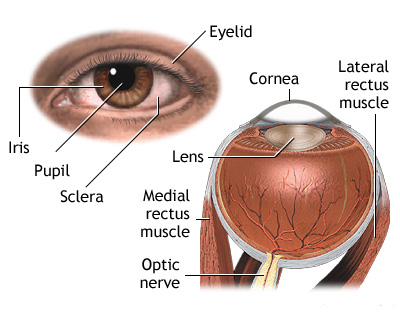
Fuchs' (pronounced Fooks) dystrophy is an eye disease in which cells lining the inner surface of the cornea slowly start to die off. The disease usually affects both eyes.
Fuchs' dystrophy can be inherited, which means it can be passed down from parents to children. If either of your parents has the disease, you have a 50% chance of developing the condition.
However, the condition may also occur in persons without a known family history of the disease.
Fuchs' dystrophy is more common in women than in men. Vision problems usually do not appear before age 50, although doctors may be able to see signs of the disease in affected persons at an earlier age, usually in their 30s and 40s.
Fuchs' dystrophy affects the thin layer of cells that line the back part of the cornea. These cells help pump excess fluid out of the cornea. As more and more cells are lost, fluid begins to build up in the cornea, causing swelling and a cloudy cornea.
At first, fluid may build up only during sleep, when the eye is closed. As the disease gets worse, small blisters may form. The blisters get bigger and may eventually break, causing eye pain. Fuchs' dystrophy can also cause the shape of the cornea to change, causing further vision problems.
Deep lamellar keratoplasty (DLK) is an alternative to a traditional transplant. In this procedure, only the deep layers of the cornea are replaced with donor tissue. The procedure requires no stitches. Recovery time is faster and there are fewer complications, such as rejection.
Fuchs' dystrophy gets worse over time. Without a corneal transplant, a patient with severe Fuchs' dystrophy may become blind or have severe pain and very reduced vision.
Mild cases of Fuchs' dystrophy often worsen after cataract surgery. A cataract surgeon will evaluate this risk and may modify the technique or the timing of your cataract surgery.
There is no known prevention. Avoiding cataract surgery or taking special precautions during cataract surgery may help slow down the course of the disease.