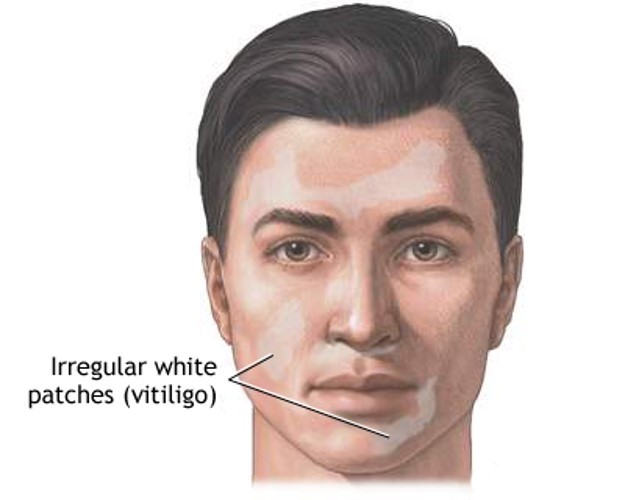
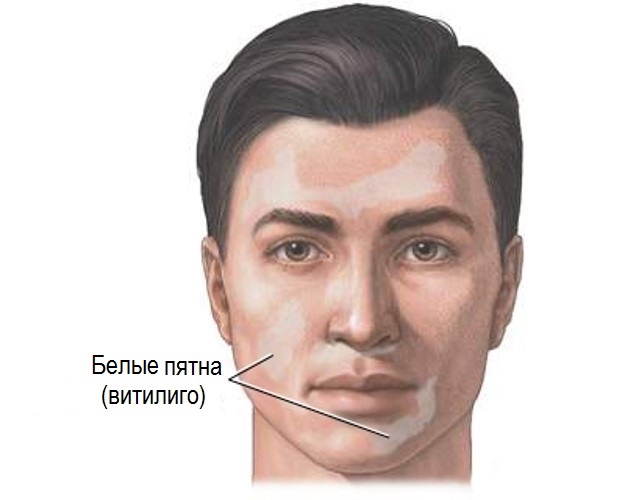
Vitiligo is a skin condition in which there is a loss of color (pigment) from areas of skin. This results in uneven white patches that have no pigment, but the skin feels like normal.
Vitiligo seems to occur when immune cells destroy the cells that make brown pigment (melanocytes). This destruction is thought to be due to an autoimmune problem. But, the exact cause of vitiligo is unknown.
Vitiligo may appear at any age. There is an increased rate of the condition in some families.
Vitiligo is associated with other autoimmune diseases:
Flat areas of normal-feeling skin without any pigment appear suddenly or gradually. These areas have a darker border. The edges are well defined, but irregular.
Vitiligo most often affects the face, elbows and knees, back of the hands and feet, and genitals. It affects both sides of the body equally.
Vitiligo is more noticeable in darker-skinned people because of the contrast of white patches against dark skin.
Your health care provider can usually examine your skin to confirm the diagnosis.
Sometimes, the provider may use a Wood light. This is a handheld ultraviolet light that causes the areas of skin with less pigment to glow bright white.
In some cases, a skin biopsy may be needed to rule out other causes of pigment loss. Your provider may also perform blood tests to check the levels of thyroid or other hormones, glucose level, and vitamin B12.
Vitiligo is difficult to treat. Early treatment options include the following:
· Phototherapy, a medical procedure in which your skin is carefully exposed to ultraviolet light. Phototherapy may be given alone, or after you take a drug that makes your skin sensitive to light. A dermatologist performs this treatment.
· Certain lasers may help the skin repigment.
· Medicines applied to the skin, such as corticosteroid creams or ointments, immunosuppressant creams or ointments such as pimecrolimus (Elidel) and tacrolimus (Protopic), or topical drugs such as methoxsalen (Oxsoralen) may also help.
Skin may be moved (grafted) from normally pigmented areas and placed onto areas where there is pigment loss.
Several cover-up makeups or skin dyes can mask vitiligo. Ask your provider for the names of these products.
In extreme cases when most of the body is affected, the remaining skin that still has pigment may be depigmented. This is a permanent change that is used as a last option.
It is important to remember that skin without pigment is at greater risk for sun damage. Be sure to apply a broad-spectrum (UVA and UVB), high-SPF sunscreen or sunblock. Sunscreen can also be helpful for making the condition less noticeable, because unaffected skin may not darken in the sun. Use other safeguards against sun exposure, such as wearing a hat with a broad rim and long sleeve shirt and pants.
The course of vitiligo varies and is unpredictable. Some areas may regain normal pigment (coloring), but other new areas of pigment loss may appear. Skin that is repigmented may be slightly lighter or darker than the surrounding skin. Pigment loss may get worse over time.
Витилиго — это заболевание кожи, которое характеризуется развитием пятен белого цвета вследствие потери или снижения функции меланоцитов, прежде всего в коже, волосах, сетчатке глаз. Болезнь может начаться в любом возрасте, но в 70% случаев — до 20 лет. Вопрос о причинах и механизмах возникновения витилиго однозначно не решен, а, следовательно, нерешенной остается проблема эффективного и полноценного лечения данного заболевания.
Лечение витилиго
Используют растительные препараты, которые повышают чувствительность кожи к ультрафиолетовым лучам. Получены обнадеживающие результаты у больных витилиго при применении экстракта зверобоя наружно и внутрь в сочетании с солнцелечением или облучением ртутно-кварцевой лампой. Имеются сообщения об успешном применении целого ряда лекарственных растений в лечении витилиго. Так, больным рекомендуют втирать в очаги обесцвечивания сок (настойку) травы, плодов пастернака посевного, сок из листьев и зеленых плодов инжира обыкновенного, красного стручкового перца, свежий сок, густой настой или отвар (1:1, 1:2) ряски маленькой, свежий сок земляники.
Для достижения эффекта прием этих препаратов сочетают с облучением кожи ультрафиолетовым светом. Наиболее эффективен прием препаратов в сочетании с длинноволновым УФ-облучением (длина волны 320–390 нм) — так называемый метод ПУВА-терапии, или фотохимиотерапии (ФХТ). Нужно соблюдать многокурсовость лечения с коротким межкурсовым периодом, что уменьшает вероятность ослабления положительного эффекта.
Полное излечение больных невозможно без устранения сопутствующих заболеваний. Витилиго - “кожный маркер внутренней болезни”. Так, у больных витилиго высока частота заболеваний печени. В связи с этим в комплексную терапию рекомендуется включать препараты, улучшающие функционирование печени и желчного пузыря,— эссенциале, холагогум. Характерна полная взаимозависимость наступления эффекта от лечения заболеваний печени: отмечены случаи выздоровления после излечения выявленного лямблиоза печени гастроэнтерологами без какого-либо специфического лечения витилиго.
Некоторые авторы предполагают, что депигментацию (обесцвечивание) могут провоцировать гельминты, нарушая нормальную деятельность желез внутренней секреции и приводя к дефициту меди в организме. Проводимая в таких случаях дегельминтизация способствовала излечению больных.
Очень частой сопутствующей патологией у больных витилиго является эндокринная патология: нарушение функций щитовидной железы; изменения со стороны ЖКТ — нарушения кислотообразующей и двигательной функций желудка; заболевания сердечно-сосудистой системы.