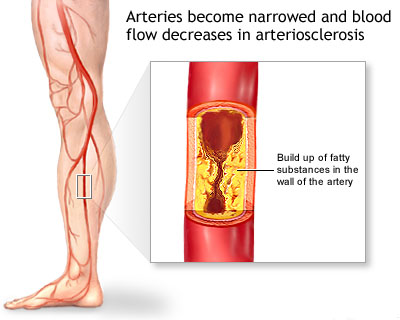
Peripheral artery disease is a condition of the blood vessels that leads to narrowing and hardening of the arteries that supply the legs and feet.
The narrowing of the blood vessels leads to decreased blood flow, which can injure nerves and other tissues.
Atherosclerosis of the extremities is a disease of the peripheral blood vessels that is characterized by narrowing and hardening of the arteries that supply the legs and feet. The narrowing of the arteries causes a decrease in blood flow. Symptoms include leg pain, numbness, cold legs or feet and muscle pain in the thighs, calves or feet.
Peripheral artery disease is caused by arteriosclerosis, or "hardening of the arteries." This problem occurs when fatty material (plaque) builds up on the walls of your arteries. This causes the arteries to become narrower. The walls of the arteries also become stiffer and cannot widen (dilate) to allow greater blood flow when needed.
As a result, when the muscles of your legs are working harder (such as during exercise or walking) they cannot get enough blood and oxygen. Eventually, there may not be enough blood and oxygen, even when the muscles are resting.
Peripheral artery disease is a common disorder that usually affects men over age 50. People are at higher risk if they have a history of:
The classic symptoms are pain, achiness, fatigue, burning, or discomfort in the muscles of your feet, calves, or thighs. These symptoms usually appear during walking or exercise and go away after several minutes of rest.
At first, these symptoms may appear only when you walk uphill, walk faster, or walk for longer distances.
Slowly, these symptoms come on more quickly and with less exercise.
Your legs or feet may feel numb when you are at rest. The legs also may feel cool to the touch, and the skin may look pale.
When peripheral artery disease becomes severe, you may have:
Balance exercise with rest. Walk or do another activity to the point of pain and alternate it with rest periods. Over time, your circulation may improve as new, small (collateral) blood vessels form. Always talk to the doctor before starting an exercise program.
Stop smoking. Smoking narrows the arteries, decreases the blood's ability to carry oxygen, and increases the risk of forming clots (thrombi and emboli).
Take care of your feet, especially if you also have diabetes. Wear shoes that fit properly. Pay attention to any cuts, scrapes, or injuries, and see your doctor right away. Tissues heal slowly and are more likely to get infected when there is decreased circulation.
Monitor your blood sugar levels if you have diabetes, and keep them under control.
Medications may be needed to control the disorder, including:
Aspirin or a medicine called clopidogrel (Plavix), which keeps your blood from forming clots in your arteries. Do NOT stop taking these medications without first talking with your doctor.
Cilostazol, a medication to enlarge (dilate) the affected artery or arteries for moderate-to-severe cases that are not candidates for surgery
Medicine to help lower your cholesterol
Pain relievers
If you are taking medicines for high blood pressure or diabetes, take them as your doctor has prescribed.
Surgery may be performed if the condition is severe and is affecting your ability to work or do important activities, or you are having pain at rest. Options are: