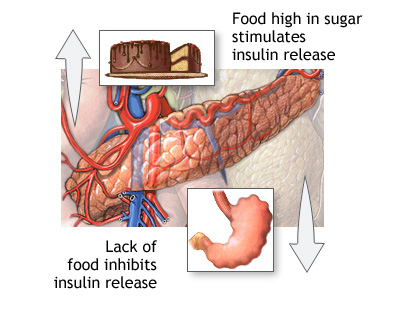
Insulin is a hormone produced by the pancreas to control blood sugar. Diabetes can be caused by too little insulin, resistance to insulin, or both.
To understand diabetes, it is important to first understand the normal process by which food is broken down and used by the body for energy. Several things happen when food is digested:
A sugar called glucose enters the bloodstream. Glucose is a source of fuel for the body.
An organ called the pancreas makes insulin. The role of insulin is to move glucose from the bloodstream into muscle, fat, and liver cells, where it can be used as fuel.
People with diabetes have high blood sugar because their body cannot move sugar into fat, liver, and muscle cells to be stored for energy. This is because either:
Their pancreas does not make enough insulin
Their cells do not respond to insulin normally
Both of the above
There are two major types of diabetes. The causes and risk factors are different for each type:
Type 1 diabetes can occur at any age, but it is most often diagnosed in children, teens, or young adults. In this disease, the body makes little or no insulin. Daily injections of insulin are needed. The exact cause is unknown.
Type 2 diabetes makes up most diabetes cases. It most often occurs in adulthood. But because of high obesity rates, teens and young adults are now being diagnosed with it. Many people with type 2 diabetes do not know they have it.
There are other causes of diabetes, and some patients cannot be classified as type 1 or type 2.
Gestational diabetes is high blood sugar that develops at any time during pregnancy in a woman who does not have diabetes.
A urine analysis may show high blood sugar. But a urine test alone does not diagnose diabetes.
Your health care provider may suspect that you have diabetes if your blood sugar level is higher than 200 mg/dL. To confirm the diagnosis, one or more of the following tests must be done.
Blood tests:
Fasting blood glucose level -- diabetes is diagnosed if it is higher than 126 mg/dL twice. Levels between 100 and 126 mg/dL are called impaired fasting glucose or pre-diabetes. These levels are risk factors for type 2 diabetes.
Oral glucose tolerance test -- diabetes is diagnosed if glucose level is higher than 200 mg/dL 2 hours after drinking a glucose drink. (This test is used more often for type 2 diabetes.)
Screening for type 2 diabetes in people who have no symptoms is recommended for:
Overweight children who have other risk factors for diabetes, starting at age 10 and repeated every 2 years
Overweight adults (BMI greater than 25) who have other risk factors
With type 2 diabetes, the disease may be reversed with lifestyle changes, especially losing weight through exercising and eating healthier foods. Also, some cases of type 2 diabetes can be improved with weight-loss surgery.
There is no cure for type 1 diabetes.
Treating both type 1 diabetes and type 2 diabetes involves medicines, diet, and exercise to control blood sugar level.
Getting better control over your blood sugar, cholesterol, and blood pressure levels helps reduce the risk of kidney disease, eye disease, nervous system disease, heart attack, and stroke.
To prevent diabetes complications, visit your health care provider at least two to four times a year. Talk about any problems you are having. Follow your health care provider's instructions on managing your diabetes.
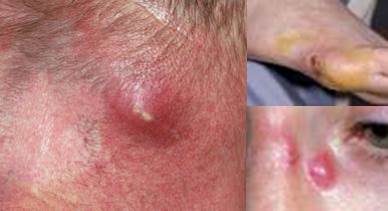
An abscess is an infection characterized by a collection of pus underneath a portion of the skin. Bacteria commonly causing abscesses are Staphylococcus aureus and Streptococcus. These bacteria enter the skin through any cracks or injury to the skin. That area of skin then becomes red, tender, warm, and swollen over days to 1–2 weeks and a fever may develop. Abscesses can sometimes form if minor superficial skin infections are not treated appropriately and in a timely fashion. Most abscesses resolve quickly once appropriately treated.
Community-associated methicillin-resistant Staphylococcus aureus (CA-MRSA) is a strain of "staph" bacteria resistant to antibiotics in the penicillin family, which have been the cornerstone of antibiotic therapy for staph and skin infections for decades. CA-MRSA previously infected only small segments of the population, such as health care workers and persons using injection drugs. However, CA-MRSA is now a common cause of skin infections in the general population. While CA-MRSA bacteria are resistant to penicillin and penicillin-related antibiotics, most staph infections with CA-MRSA can be easily treated by health care practitioners using local skin care and commonly available non-penicillin-family antibiotics. Rarely, CA-MRSA can cause serious skin and soft tissue (deeper) infections. Staph infections typically start as small red bumps or pus-filled bumps, which can rapidly turn into deep, painful sores. If you see a red bump or pus-filled bump on the skin that is worsening or showing any signs of infection (ie, the area becomes increasingly painful, red, or swollen), see your doctor right away. Many patients believe incorrectly that these bumps are the result of a spider bite when they arrive at the doctor's office. Your doctor may need to test (culture) infected skin for MRSA before starting antibiotics. If you have a skin problem that resembles a CA-MRSA infection or a culture that is positive for MRSA, your doctor may need to provide local skin care and prescribe oral antibiotics. To prevent spread of infection to others, infected wounds, hands, and other exposed body areas should be kept clean and wounds should be covered during therapy.
Factors that predispose individuals to developing an abscess include:
Any skin infection, especially those that are untreated
Abscesses can occur in anyone and occur anywhere on the body. You might be able to sense fluid in an abscess when you press on the abscess with a finger.
A worsening red, tender swelling that arises over a period of 1–2 weeks. The pus underneath the skin is usually not visible. You may have a fever or a general sense of not feeling well.
There are no self-care options for abscesses. While waiting to see your doctor, you can try applying a warm compress to the affected area and take ibuprofen to help with the swelling and pain.
A worsening red, tender swelling should prompt you to make an appointment with your physician as soon as possible. If the area involves your face, is spreading rapidly, or is in an area that severely limits your functionality, you should seek emergency care.
Your doctor may drain the pus and fluid collection by making a small incision in the skin after it has been numbed. This will drain a majority of the bacteria, helping the body fight the small amount that remains. This fluid may then be sent to a laboratory for testing (culture), but not necessarily. The culture can tell the doctor not only what type of bacterium is causing the infection but also what antibiotics will work best to treat it. This may take as little as 2–3 days. Your doctor may choose to have you start oral antibiotics aimed at treating the most common bacteria that cause abscesses while awaiting these results. However, if the infection is small and it has been drained, your doctor may decide to not treat you with oral antibiotics.
If your symptoms are not improving or it is determined that the bacterium is not one of the common types, your doctor may prescribe different antibiotics. If your doctor prescribes antibiotics, it is important to take the entire course as prescribed, even if you are feeling better or the infection appears to be gone after just a few days. If you have been taking antibiotics and the infection itself or the way you are generally feeling have not improved in about 2–3 days, return to see your doctor.
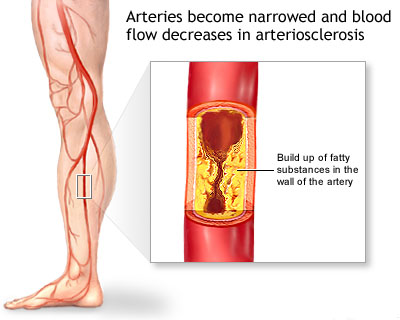
Peripheral artery disease is a condition of the blood vessels that leads to narrowing and hardening of the arteries that supply the legs and feet.
The narrowing of the blood vessels leads to decreased blood flow, which can injure nerves and other tissues.
Atherosclerosis of the extremities is a disease of the peripheral blood vessels that is characterized by narrowing and hardening of the arteries that supply the legs and feet. The narrowing of the arteries causes a decrease in blood flow. Symptoms include leg pain, numbness, cold legs or feet and muscle pain in the thighs, calves or feet.
Peripheral artery disease is caused by arteriosclerosis, or "hardening of the arteries." This problem occurs when fatty material (plaque) builds up on the walls of your arteries. This causes the arteries to become narrower. The walls of the arteries also become stiffer and cannot widen (dilate) to allow greater blood flow when needed.
As a result, when the muscles of your legs are working harder (such as during exercise or walking) they cannot get enough blood and oxygen. Eventually, there may not be enough blood and oxygen, even when the muscles are resting.
Peripheral artery disease is a common disorder that usually affects men over age 50. People are at higher risk if they have a history of:
The classic symptoms are pain, achiness, fatigue, burning, or discomfort in the muscles of your feet, calves, or thighs. These symptoms usually appear during walking or exercise and go away after several minutes of rest.
At first, these symptoms may appear only when you walk uphill, walk faster, or walk for longer distances.
Slowly, these symptoms come on more quickly and with less exercise.
Your legs or feet may feel numb when you are at rest. The legs also may feel cool to the touch, and the skin may look pale.
When peripheral artery disease becomes severe, you may have:
Balance exercise with rest. Walk or do another activity to the point of pain and alternate it with rest periods. Over time, your circulation may improve as new, small (collateral) blood vessels form. Always talk to the doctor before starting an exercise program.
Stop smoking. Smoking narrows the arteries, decreases the blood's ability to carry oxygen, and increases the risk of forming clots (thrombi and emboli).
Take care of your feet, especially if you also have diabetes. Wear shoes that fit properly. Pay attention to any cuts, scrapes, or injuries, and see your doctor right away. Tissues heal slowly and are more likely to get infected when there is decreased circulation.
Monitor your blood sugar levels if you have diabetes, and keep them under control.
Medications may be needed to control the disorder, including:
Aspirin or a medicine called clopidogrel (Plavix), which keeps your blood from forming clots in your arteries. Do NOT stop taking these medications without first talking with your doctor.
Cilostazol, a medication to enlarge (dilate) the affected artery or arteries for moderate-to-severe cases that are not candidates for surgery
Medicine to help lower your cholesterol
Pain relievers
If you are taking medicines for high blood pressure or diabetes, take them as your doctor has prescribed.
Surgery may be performed if the condition is severe and is affecting your ability to work or do important activities, or you are having pain at rest. Options are: