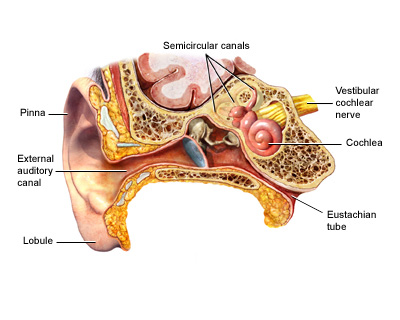
The ear consists of external, middle, and inner structures. The eardrum and the 3 tiny bones conduct sound from the eardrum to the cochlea.
Tiny hair cells inside your inner ear help you hear. They pick up sound waves and change them into the nerve signals that the brain interprets as sound. Hearing loss occurs when the tiny hair cells are damaged or die. The hair cells do not regrow, so most hearing loss caused by hair cell damage is permanent.
There is no known single cause of age-related hearing loss. Most commonly, it is caused by changes in the inner ear that occur as you grow older. Your genes and loud noise (such as from rock concerts or music headphones) may play a large role.
The following factors contribute to age-related hearing loss:
Family history (age-related hearing loss tends to run in families)
Repeated exposure to loud noises
Smoking (smokers are more likely to have such hearing loss than nonsmokers)
Your health care provider will do a complete physical exam. This helps find if a medical problem is causing your hearing loss. Your health care provider will use an instrument called an otoscope to look in your ears. Sometimes, earwax can block the ear canals and cause hearing loss.
You may be sent to an ear, nose, and throat doctor and a hearing specialist (audiologist). Hearing tests can help determine the extent of hearing loss.
There is no cure for age-related hearing loss. Treatment is focused on improving your everyday function. The following may be helpful:
Hearing aids
Telephone amplifiers and other assistive devices
Sign language (for those with severe hearing loss)
Speech reading (such as lip reading and using visual cues to aid communication)
A cochlear implant may be recommended for persons with severe hearing loss. Surgery is done to place the implant. The implant allows the person to detect sounds again and with practice can allow the person to understand speech. But it does not restore normal hearing.
Age-related hearing loss most often gets worse slowly. The hearing loss cannot be reversed and may lead to deafness.
Hearing loss may cause you to avoid leaving home. Seek help from your health care provider and family and friends to avoid becoming isolated. Hearing loss can be managed so that you can continue to live a full and active life.
Hearing loss should be checked as soon as possible. This helps rule out causes such as too much wax in the ear or side effects of medicines. Your health care provider should have you get a hearing test.
Contact your health care provider right away if you have a sudden change in your hearing or hearing loss with other symptoms such as headache, vision changes, or dizziness.
Старческая тугоухость – это прогрессирующая потеря способности слышать высокие частоты, которая возникает с возрастом. Начальным симптомом являются проблемы восприятия речи, особенно при наличии фонового шума.
Неизвестно существует ли особая причина, способствующая старческой потери слуха, например, такая как долгое воздействие сильного шума. Однако, создается впечатление, что это генетические условия, поскольку существует тенденция возникновения пресбикуаза в семьях.
Количество нервных клеток в среднем ухе может начать уменьшаться после 30 либо 40 лет, хотя значительная потеря слуха редко происходит раньше 55 лет. Однако, потеря слуха не обязательно является неизбежной частью старческого процесса, многие люди сохраняют слух в свои 80 лет.
Как излечить возрастную потерю слуха пока не известно. Лечение фокусируется на улучшении функций, таких как, например, использование слуховых аппаратов.