Dehydration means your body does not have as much water and fluids as it should.
Dehydration can be mild, moderate, or severe based on how much of the body's fluid is lost or not replenished. When it is severe, dehydration is a life-threatening emergency.
Dehydration in sick children is often a combination of refusing to eat or drink anything and losing fluid from vomiting, diarrhea, or fever.
Infants and children are more likely to become dehydrated than adults because they weigh less and their bodies turn over water and electrolytes more quickly. The elderly and people with illnesses are also at higher risk.
You may also have vomiting, diarrhea, or the feeling that you "can't keep anything down." All of these can be causing the dehydration.
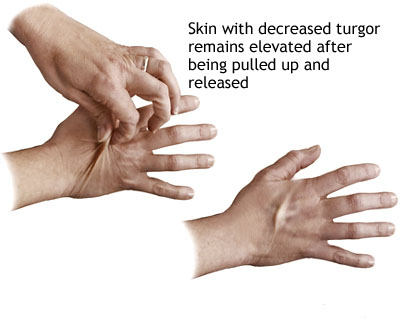
A decrease in skin turgor is indicated when the skin (on the back of the hand for an adult or on the abdomen for a child) is pulled up for a few seconds and does not return to its original state. A decrease in skin turgor is a late sign of dehydration.
Poor skin turgor -- the skin may not be as elastic as normal and sag back into position slowly when the health care provider pinches it up into a fold (normally, skin springs right back into place)
Drinking fluids is usually enough for mild dehydration. It is better to drink small amounts of fluid often (using a teaspoon or syringe for an infant or child), instead of trying to force large amounts of fluid at one time. Drinking too much fluid at once can bring on more vomiting.
Electrolyte solutions or freezer pops are very effective. These are available at pharmacies. Sports drinks contain a lot of sugar and can cause or worsen diarrhea. In infants and children, avoid using water as the primary replacement fluid.
Intravenous fluids and a hospital stay may be needed for moderate to severe dehydration. The health care provider will try to identify and then treat the cause of the dehydration.
Most cases of stomach viruses (also called viral gastroenteritis) tend to get better on their own after a few days. See also: Diarrhea
Even when you are healthy, drink plenty of fluids every day. Drink more when the weather is hot or you are exercising.
Carefully monitor someone who is ill, especially an infant, child, or older adult. If you believe that the person is getting dehydrated, call your health care provider before the person becomes dehydrated. Begin fluid replacement as soon as vomiting and diarrhea start -- DO NOT wait for signs of dehydration.
Always encourage a person who is sick to drink fluids. Remember that fluid needs are greater with a fever, vomiting, or diarrhea. The easiest signs to monitor are urine output (there should be frequent wet diapers or trips to the bathroom), saliva in the mouth, and tears when crying.
What is traveler's diarrhea?
People get traveler's diarrhea by eating food and drinking water that contain germs. People can get this illness in areas of the world where the drinking water is not clean.
People who live these areas often drink tap water that contains these germs, but they do not get diarrhea. This is because their bodies are used to the germs. In the same way, cooks and food handlers may have the germs that cause traveler's diarrhea on their hands, but they may not get sick themselves. When people travel to a new place, they are more likely to become sick, because they lack protective antibodies (infection-fighting agents in the blood) that attack these germs.
How can I tell if I have traveler's diarrhea?
You may have traveler's diarrhea if you have at least 3 loose stools in 24 hours. You may also have one or more of the following symptoms:
Even if you don't treat traveler's diarrhea, it will usually go away in 4 to 5 days. You should drink plenty of clear liquids to replace lost fluids due to the diarrhea. Taking medicine to treat traveler's diarrhea may make you feel better more quickly. It often is treated with antibiotics (medicines that kill bacteria). To get antibiotics, you need a prescription from your doctor.
You also can take a medicine called loperamide (brand name: Imodium). However, if you have bloody diarrhea, you should not take this medicine without also taking an antibiotic.
Children, pregnant women, older adults and other people who get dehydrated easily should drink rehydration solutions. Rehydration solutions help replace the fluid you lose while you are sick. You can buy packets of rehydration salts (to be mixed with safe water) at camping/outdoor stores or drug stores.
When should I contact my doctor?
If your child has a fever higher than 102°F, is dehydrated, has blood in the stool or vomits several times, he or she should see a doctor right away.
If treating your traveler's diarrhea isn't helping you to feel better, talk to your doctor.
How can I avoid traveler's diarrhea?
When you will be traveling to an area where the water may not be clean, see your doctor 4 to 6 weeks before your trip. Your doctor may want to give you some medicines, such as antibiotics or shots, to protect you from illness while you are away. During your trip, be careful about the following things:
Do not drink tap water and do not use it to brush your teeth.
Do not drink bottled water if the seal on the bottle has been broken.
Do not use ice unless you're sure it's made from purified water.
Do not drink milk or eat dairy products that have not been pasteurized (heated to a temperature that kills all germs).
Do not eat raw fruits or vegetables unless they can be peeled and you are the one who peels them.
Do not eat cut-up fruit salad.
Do not eat lettuce or other leafy raw vegetables (such as spinach).
Do not eat raw or rare (slightly cooked) meat or fish.
Do not eat food from people who sell it on the street.
Boiling water will kill the germs that cause diarrhea, making the water safe to drink. Boil water vigorously for 1 minute and allow it to cool to room temperature (do not add ice). When traveling in high altitudes (6,562 feet or higher), boil water for 3 minutes.
What is safe to eat or drink?
When you are in a place where you could get traveler's diarrhea, it is probably safe to eat or drink the following:
Soft drinks that are carbonated (such as cola).
Hot drinks, such as tea or coffee.
Carbonated or noncarbonated bottled water, as long as you are the one who breaks the seal on the bottle.
Raw fruits or vegetables that can be peeled, as long as you are the one who peels them.
Food that is served hot.
Meat that is well cooked.
Questions to Ask Your Doctor
Is there medicine I can take to prevent traveler’s diarrhea?
Is traveler’s diarrhea common in the country I’m traveling to?
If I get traveler’s diarrhea, who should I contact and when?
Рвота и диарея (понос) могут быть опасны, потому что они могут привести к обезвоживанию организма. Обезвоживание развивается при потере организмом большого количества жидкости. У маленьких детей обезвоживание развивается быстро, но оно может возникнуть в любом возрасте.
Рвота и понос могут быть симптомом вирусных, бактериальных, паразитарных заболеваний, быть следствием приема некоторых лекарственных препаратов и некоторых заболеваний. Нарушение переваривания некоторых продуктов (например, большого количества сладостей) и недоваренного мяса или рыбы также может вызвать рвоту и диарею.
Любому человеку с приступами рвоты или диареи необходимо возместить потерянную жидкость и электролиты.
· Для грудных детей: Если вы кормите грудью, продолжайте давать ребенку грудное молоко. В грудном молоке содержится жидкость и электролиты, необходимые для предотвращения обезвоживания. Также врач может назначить ребенку прием растворов для пероральной регидратации (ДАТЬ ССЫЛКУ). Если вы кормите ребенка молочной смесью, попробуйте на время перейти на смесь, не содержащую лактозу. Лактоза может ухудшить диарею. Врач может посоветовать на 12-24 часа переключиться с молочных смесей на прием пероральных растворов для регидратации.
· Для маленьких детей: Используйте растворы для пероральной регидратации (ДАТЬ ССЫЛКУ), содержащие соль, сахар, калий и другие питательные вещества для возмещения потерянной жидкости. Детям старше 1 года для предотвращения обезвоживания также можно давать супы, сок, наполовину смешанный с водой. Не стоит давать ребенку воду и напитки. В воде не содержится необходимого количества соли и питательных веществ для борьбы с обезвоживанием. В напитках, как правило, содержится много сахара, который может раздражать желудок вашего ребенка.
Обычно нет. Как правило, рвота и понос проходят быстро. При инфекциях рвота и диарея являются защитной реакцией организма, направленной на выведение инфекционного агента из организма. Прием лекарств, останавливающих рвоту и понос, может препятствовать самовосстановлению организма. В антибиотиках, как правило, также нет необходимости. Обратитесь к врачу, если вы считаете, что вам или вашему ребенку необходимы лекарственные препараты.
Очень сложно сказать, развилось ли у ребенка обезвоживание. Как правило, ко времени появления симптомов обезвоживания, оно уже успевает перейти в тяжелую степень. Обратитесь к врачу, если вы заметили любой из нижеследующих симптомов обезвоживания, особенно у младенцев и детей раннего возраста. В случае тяжелого обезвоживания для возмещения потерянной при рвоте и диареи жидкости пациенту может потребоваться внутривенное вливание жидкостей.
Рвота и диарея (понос) могут быть опасны, потому что они могут привести к обезвоживанию организма. Обезвоживание развивается при потере организмом большого количества жидкости. У пожилых людей обезвоживание развивается быстро, но оно может возникнуть в любом возрасте.
Рвота и понос могут быть симптомом вирусных, бактериальных, паразитарных заболеваний, быть следствием приема некоторых лекарственных препаратов и некоторых заболеваний. Нарушение переваривания некоторых продуктов и недоваренного мяса или рыбы также может вызвать рвоту и диарею.
Любому человеку с приступами рвоты или диареи необходимо возместить потерянную жидкость и электролиты.
Для возмещения потерянной при рвоте и диарее жидкости взрослые и пожилые люди должны выпивать, по крайней мере, по 7-8 стаканов воды каждый день. Пожилым людям для восполнения потерянной жидкости могут быть назначены растворы для пероральной регидратации.
Обычно нет. Как правило, рвота и понос проходят быстро. При инфекциях рвота и диарея являются защитной реакцией организма, направленной на выведение инфекционного агента из организма. Прием лекарств, останавливающих рвоту и понос, может препятствовать самовосстановлению организма. В антибиотиках, как правило, также нет необходимости. Обратитесь к врачу, если вы считаете, что необходимы лекарственные препараты.
Очень сложно сказать, имеется ли у человека обезвоживание. Как правило, ко времени появления симптомов обезвоживания, оно уже успевает перейти в тяжелую степень. Обратитесь к врачу, если вы заметили любой из нижеследующих симптомов обезвоживания, особенно у пожилых людей. В случае тяжелого обезвоживания для возмещения потерянной при рвоте и диареи жидкости пациенту может потребоваться внутривенное вливание жидкостей.