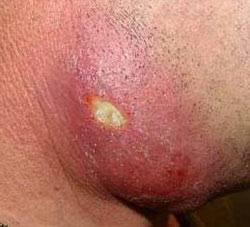
Фолликулит – бұл тері астында орналасқан шағын қалташалар - фолликулдардың инфекциясы немесе қабынуы, фоликулдарда шаш түзіліп, өседі. Фолликулит дененің кез келген бөлігінде пайда болуы мүмкін, бірақ, ол шаш түбінде, киімнің денеге үйкелетін тұстарында – мысалы, қолда, бөкседе жиі болады.
Фолликулиттің жиі себебі – бактериалдық инфекция, бірақ, зеңдік инфекциядан да туындауы мүмкін.
Фолликулит шаштың бір немесе бірнеше шумағының маңында немесе түбінде қызарған, ауырсынатын аумақ түрінде басталады. Одан кейін бұл бөлік терідегі іріңді төмпешікке (пустула) айналады, ол кейде қышып, күйдіретін сезім береді. Пустуланы ашқанда ірің және/немесе қан шығуы мүмкін.
Инфекциялық фолликулиттің терінің бетіне жақын орналасатын жеңіл жағдайлар әдетте, өздігінше, шамамен 2 аптадан кейін жазылады. Терең және күрделі инфекциялық фолликулитте әдетте, ішетін антибиотиктер мен зеңге қарсы препараттар жақсы көмектеседі.
For patients in the hospital, common sites of infection include intravenous lines, surgical wounds, surgical drains, and sites of skin breakdown, known as bedsores or pressure ulcers.
In sepsis, blood pressure drops, resulting in shock. Major organs and body systems, including the kidneys, liver, lungs, and central nervous system stop working properly because of poor blood flow.
The health care provider will examine the person and ask about the person's medical history.
The infection is often confirmed by a blood test. But a blood test may not reveal infection in people who have been receiving antibiotics. Some infections that can cause sepsis cannot be diagnosed by a blood test.
A person with sepsis will be admitted to a hospital, usually in the intensive care unit (ICU). Antibiotics are usually given through a vein (intravenously).
Oxygen is given to the person. Large amounts of fluids are given through a vein. Other medical treatments include:
Sepsis is often life threatening, especially in people with a weakened immune system or a long-term (chronic) illness.
Damage caused by a drop in blood flow to vital organs such as the brain, heart, and kidneys may take time to improve. There may be long-term problems with these organs.
The risk of sepsis can be reduced by getting all recommended vaccines.
In the hospital, careful hand washing can help prevent infections that lead to sepsis. Prompt removal of urinary catheters and IV lines when they are no longer needed can also help prevent infections that lead to sepsis.
Ear infections are one of the most common reasons parents take their children to the doctor. The most common type of ear infection is called otitis media. It is caused by swelling and infection of the middle ear. The middle ear is located just behind the eardrum.
An acute ear infection starts over a short period of time and is painful. Ear infections that last a long time or come and go are called chronic ear infections.
Causes
The eustachian tube runs from the middle of each ear to the back of the throat. Normally, this tube drains fluid that is made in the middle ear. If this tube becomes blocked, fluid can build up. This can lead to infection.
Ear infections are common in infants and children, because the eustachian tubes become clogged easily.
Ear infections may also occur in adults, although they are less common than in children.
Anything that causes the eustachian tubes to become swollen or blocked causes more fluid to build up in the middle ear behind the eardrum. Some causes are:
Infected or overgrown adenoids (lymph tissue in the upper part of the throat)
Tobacco smoke
Ear infections are also more likely in children who spend a lot of time drinking from a sippy cup or bottle while lying on their back. However, getting water in the ears will not cause an acute ear infection, unless the eardrum has a hole in it.
Acute ear infections occur most often in the winter. You cannot catch an ear infection from someone else, but a cold may spread among children and cause some of them to get ear infections.
Risk factors for acute ear infections include:
Attending day care (especially those with more than 6 children)
Changes in altitude or climate
Cold climate
Exposure to smoke
Family history of ear infections
Not being breastfed
Pacifier use
Recent ear infection
Recent illness of any type (because illness lowers the body's resistance to infection)
Symptoms
In infants, often the main sign of an ear infection is acting irritable or crying that cannot be soothed. Many infants and children with an acute ear infection have a fever or trouble sleeping. Tugging on the ear is not always a sign that the child has an ear infection.
Symptoms of an acute ear infection in older children or adults include:
The ear infection may start shortly after a cold. Sudden drainage of yellow or green fluid from the ear may mean the eardrum has ruptured.
All acute ear infections involve fluid behind the eardrum. At home, you can use an electronic ear monitor to check for this fluid. You can buy this device at a pharmacy. You still need to see your doctor to confirm an ear infection.
Exams and Tests
The health care provider will look inside the ears using an instrument called an otoscope. This may show:
Areas of dullness or redness
Air bubbles or fluid behind the eardrum
Bloody fluid or pus inside the middle ear
A hole (perforation) in the eardrum
The health care provider might recommend a hearing test if the person has a history of ear infections.
Treatment
Some ear infections will safely clear up on their own without antibiotics. Often, treating the pain and allowing the body time to heal itself is all that is needed:
Apply a warm cloth or warm water bottle to the affected ear.
Use over-the-counter pain relief drops for ears, or ask the doctor about prescription ear drops to relieve pain.
Take over-the-counter medications for pain or fever, such as ibuprofen or acetaminophen. Do NOT give aspirin to children.
All children younger than 6 months with a fever or symptoms should see the doctor. Children who are older than 6 months may be watched at home if they do NOT have:
A fever higher than 102°F (38.9°C)
More severe pain or other symptoms
Other medical problems
If there is no improvement or if symptoms get worse, schedule an appointment with your health care provider to determine whether antibiotics are needed.
ANTIBIOTICS
A virus or bacteria can cause ear infections. Antibiotics will not help an infection that is caused by a virus. Many health care providers no longer prescribe antibiotics for every ear infection. However, all children younger than 6 months with an ear infection are treated with antibiotics.
Your health care provider is more likely to prescribe antibiotics if your child:
Is under age 2
Has a fever
Appears sick
Does not improve in 24 to 48 hours
If antibiotics are prescribed, it is important to take them every day and to take all of the medicine. Do NOT stop the medicine when symptoms go away. If the antibiotics do not seem to be working within 48 to 72 hours, contact your doctor. You may need to switch to a different antibiotic.
Side effects of antibiotics may include nausea, vomiting, and diarrhea. Although rare, serious allergic reactions may also occur.
Some children have repeat ear infections that seem to go away between episodes. They may receive a smaller, daily dose of antibiotics to prevent new infections.
SURGERY
If an infection does not go away with the usual medical treatment, or if a child has many ear infections over a short period of time, the doctor may recommend ear tubes.
A tiny tube is inserted into the eardrum, keeping open a small hole that allows air to get in so fluids can drain more easily.
Usually the tubes fall out by themselves. Those that don't fall out may be removed in your doctor's office.
If the adenoids are enlarged, removing them with surgery may be considered if ear infections continue to occur. Removing tonsils does not seem to help prevent ear infections.
Outlook (Prognosis)
Most often, an ear infection is a minor problem that gets better. Ear infections can be treated, but may occur again in the future.
Most children will have minor, short-term hearing loss during and right after an ear infection. This is due to fluid in the ear. Fluid can stay behind the eardrums for weeks or even months after the infection has cleared.
Speech or language delay is uncommon, but it may occur in a child who has lasting hearing loss from many, repeated ear infections.
Possible Complications
Rarely, a more serious infection may develop, such as
Mastoiditis (an infection of the bones around the skull)
Pain, fever, or irritability do not improve within 24 to 48 hours
At the start, the child seems sicker than just an ear infection
Your child has a high fever or severe pain
Severe pain suddenly stops -- this may indicate a ruptured eardrum
Symptoms get worse
New symptoms appear, especially severe headache, dizziness, swelling around the ear, or twitching of the face muscles
Let the doctor know right away if a child younger than 6 months has a fever, even if no other symptoms are present.
Prevention
You can reduce your child's risk of ear infections with the following practices:
Wash hands and toys often.
If possible, choose a day care that has 6 or fewer children. This can reduce your child's chances of getting a cold or other infection, and lead to fewer ear infections.
Avoid pacifiers.
Breastfeed -- this makes a child much less prone to ear infections. If you are bottle feeding, hold your infant in an upright, seated position.
Do not expose your child to secondhand smoke.
Make sure your child's immunizations are up to date. The pneumococcal vaccine prevents infections from the bacteria that most commonly cause acute ear infections and many respiratory infections.
Avoid overusing antibiotics. Overusing antibiotics can lead to antibiotic resistance.
Candida is the scientific name for yeast. It is a fungus that lives almost everywhere, including in your body. Usually, your immune system keeps yeast under control. If you are sick or taking antibiotics, it can multiply and cause an infection.
Yeast infections affect different parts of the body in different ways:
· Thrush is a yeast infection that causes white patches in your mouth
· Candida esophagitis is thrush that spreads to your esophagus, the tube that takes food from your mouth to your stomach. It can make it hard or painful to swallow.
· Women can get vaginal yeast infections, causing vaginitis
· Yeast infections of the skin cause itching and rashes
· Yeast infections in your bloodstream can be life-threatening
Antifungal medicines get rid of yeast infections in most people. If you have a weak immune system, treatment might be more difficult.
The bacteria that cause diphtheria spread through respiratory droplets (such as from a cough or sneeze) of an infected person or someone who carries the bacteria but has no symptoms.
The bacteria most commonly infects your nose and throat. The throat infection causes a gray to black, tough, fiber-like covering, which can block your airways. In some cases, diphtheria infects your skin first and causes skin lesions.
Once you are infected, the bacteria make dangerous substances called toxins. The toxins spread through your bloodstream to other organs, such as the heart and brain, and cause damage.
Because of widespread vaccination (immunization) of children, diphtheria is now rare in many parts of the world.
Risk factors for diphtheria include crowded environments, poor hygiene, and lack of immunization.
The health care provider will perform a physical exam and look inside your mouth. This may reveal a gray to black covering (pseudomembrane) in the throat, enlarged lymph glands, and swelling of the neck or vocal cords.
Tests used may include:
· Gram stain or throat culture to identify the diphtheria bacteria
· Toxin assay (to detect the presence of the toxin made by the bacteria)
If the provider thinks you have diphtheria, treatment will likely be started right away, even before test results come back.
Diphtheria antitoxin is given as a shot into a muscle or through an IV (intravenous line). The infection is then treated with antibiotics, such as penicillin and erythromycin.
You may need to stay in the hospital while getting the antitoxin. Other treatments may include:
· Fluids by IV
· Oxygen
· Bed rest
· Heart monitoring
· Insertion of a breathing tube
· Correction of airway blockages
People without symptoms who carry diphtheria should be treated with antibiotics.
The most common complication is inflammation of the heart muscle (myocarditis). The nervous system is also frequently and severely affected, which may result in temporary paralysis.
The diphtheria toxin can also damage the kidneys.
There can also be an allergic response to the antitoxin.
Contact your provider right away if you have come in contact with a person who has diphtheria.
Diphtheria is a rare disease. It is also a reportable disease, and any cases are often publicized in the newspaper or on television. This helps you to know if diphtheria is present in your area.
Routine childhood immunizations and adult boosters prevent the disease.
Anyone who has come into contact with an infected person should get an immunization or booster shot against diphtheria, if they have not already received it. Protection from the vaccine lasts only 10 years. So it is important for adults to get a booster vaccine every 10 years. The booster is called tetanus-diphtheria (Td). (The shot also has vaccine medicine for an infection called tetanus.)
If you have been in close contact with a person who has diphtheria, contact your provider right away. Ask whether you need antibiotics to prevent getting diphtheria.
Reye syndrome is sudden (acute) brain damage and liver function problems that do not have a known cause.
This syndrome has occurred in children who were given aspirin when they had chickenpox or the flu. Reye syndrome has become very rare because aspirin is no longer recommended for routine use in children.
Reye syndrome is most often seen in children ages 4 to 12. Most cases that occur with chickenpox are in children ages 5 to 9. Cases that occur with the flu are usually in children ages 10 to 14.
Children with Reye syndrome get sick very suddenly. The syndrome often begins with vomiting, which lasts for many hours. The vomiting is quickly followed by irritable and aggressive behavior. As the condition gets worse, the child may be unable to stay awake and alert.
Unusual placement of arms and legs (decerebrate posture). The arms are extended straight and turned toward the body, the legs are held straight, and the toes are pointed downward
Other symptoms that can occur with this disorder include:
There is no specific treatment for this condition. The health care provider will monitor the pressure in the brain, blood gases, and blood acid-base balance (pH).
Treatments may include:
Breathing support (a breathing machine may be needed during a deep coma)
Never give a child aspirin unless told to do so by your doctor.
When a child must take aspirin, take care to reduce the child's risk of catching a viral illness, such as the flu and chickenpox. Avoid aspirin for several weeks after the child has received a varicella (chickenpox) vaccine.
Note: Other over-the-counter medicines, such as Pepto-Bismol and substances with oil of wintergreen also contain aspirin compounds called salicylates. DO NOT give these to a child who has a cold or fever.
An abscess is an infection characterized by a collection of pus underneath a portion of the skin. Bacteria commonly causing abscesses are Staphylococcus aureus and Streptococcus. These bacteria enter the skin through any cracks or injury to the skin. That area of skin then becomes red, tender, warm, and swollen over days to 1–2 weeks and a fever may develop. Abscesses can sometimes form if minor superficial skin infections are not treated appropriately and in a timely fashion. Most abscesses resolve quickly once appropriately treated.
Community-associated methicillin-resistant Staphylococcus aureus (CA-MRSA) is a strain of "staph" bacteria resistant to antibiotics in the penicillin family, which have been the cornerstone of antibiotic therapy for staph and skin infections for decades. CA-MRSA previously infected only small segments of the population, such as health care workers and persons using injection drugs. However, CA-MRSA is now a common cause of skin infections in the general population. While CA-MRSA bacteria are resistant to penicillin and penicillin-related antibiotics, most staph infections with CA-MRSA can be easily treated by health care practitioners using local skin care and commonly available non-penicillin-family antibiotics. Rarely, CA-MRSA can cause serious skin and soft tissue (deeper) infections. Staph infections typically start as small red bumps or pus-filled bumps, which can rapidly turn into deep, painful sores. If you see a red bump or pus-filled bump on the skin that is worsening or showing any signs of infection (ie, the area becomes increasingly painful, red, or swollen), see your doctor right away. Many patients believe incorrectly that these bumps are the result of a spider bite when they arrive at the doctor's office. Your doctor may need to test (culture) infected skin for MRSA before starting antibiotics. If you have a skin problem that resembles a CA-MRSA infection or a culture that is positive for MRSA, your doctor may need to provide local skin care and prescribe oral antibiotics. To prevent spread of infection to others, infected wounds, hands, and other exposed body areas should be kept clean and wounds should be covered during therapy.
Factors that predispose individuals to developing an abscess include:
Any skin infection, especially those that are untreated
Diabetes
Obesity
Intravenous drug abuse
Weakened immune system due to underlying illness or medication
Who's At Risk
Abscesses can occur in anyone and occur anywhere on the body.
You might be able to sense fluid in an abscess when you press on the abscess with a finger.
Signs and Symptoms
A worsening red, tender swelling that arises over a period of 1–2 weeks. The pus underneath the skin is usually not visible. You may have a fever or a general sense of not feeling well.
Self-Care Guidelines
There are no self-care options for abscesses. While waiting to see your doctor, you can try applying a warm compress to the affected area and take ibuprofen to help with the swelling and pain.
When to Seek Medical Care
A worsening red, tender swelling should prompt you to make an appointment with your physician as soon as possible. If the area involves your face, is spreading rapidly, or is in an area that severely limits your functionality, you should seek emergency care.
Treatments Your Physician May Prescribe
Your doctor may drain the pus and fluid collection by making a small incision in the skin after it has been numbed. This will drain a majority of the bacteria, helping the body fight the small amount that remains. This fluid may then be sent to a laboratory for testing (culture), but not necessarily. The culture can tell the doctor not only what type of bacterium is causing the infection but also what antibiotics will work best to treat it. This may take as little as 2–3 days. Your doctor may choose to have you start oral antibiotics aimed at treating the most common bacteria that cause abscesses while awaiting these results. However, if the infection is small and it has been drained, your doctor may decide to not treat you with oral antibiotics.
If your symptoms are not improving or it is determined that the bacterium is not one of the common types, your doctor may prescribe different antibiotics. If your doctor prescribes antibiotics, it is important to take the entire course as prescribed, even if you are feeling better or the infection appears to be gone after just a few days. If you have been taking antibiotics and the infection itself or the way you are generally feeling have not improved in about 2–3 days, return to see your doctor.