Ни для кого не секрет, что частое использование компьютеров, смартфонов, мобильных телефонов и других современных гаджетов может вызывать напряжение и дискомфорт в глазах, их покраснение и слезоточивость.
Научно подтверждено, что долгие часы, проведенные за монитором компьютера или другого устройства, напрягают глаза, однако есть некоторые способы борьбы с подобным напряжением и профилактики возможного ухудшения зрения.
Myopia, also known as nearsightedness, is a common type of refractive error where close objects appear clearly, but distant objects appear blurry.
What is high myopia?
High myopia is a severe form of the condition. In high myopia, the eyeball stretches and becomes too long. This can lead to holes or tears in the retina and can also cause retinal detachment. Abnormal blood vessels may grow under the retina and cause changes in vision. People with high myopia need comprehensive dilated eye exams more often. Early detection and timely treatment can help prevent vision loss.
What is refraction?
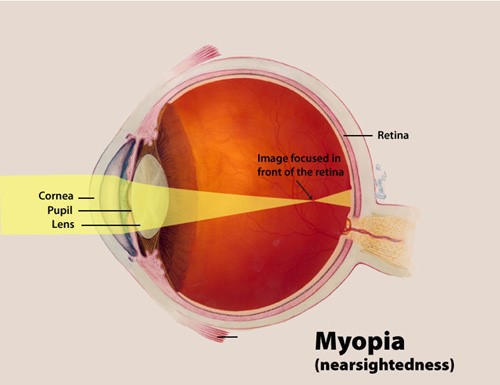
Refraction is the bending of light as it passes through one object to another. Vision occurs when light rays are bent (refracted) as they pass through the cornea and the lens. The light is then focused on the retina. The retina converts the light-rays into messages that are sent through the optic nerve to the brain. The brain interprets these messages into the images we see.
What are refractive errors?
In refractive errors, the shape of the eye prevents light from focusing on the retina. The length of the eyeball (longer or shorter), changes in the shape of the cornea, or aging of the lens can cause refractive errors.
Causes and Risk Factors
How does myopia develop?
Myopia develops in eyes that focus images in front of the retina instead of on the retina, which results in blurred vision. This occurs when the eyeball becomes too long and prevents incoming light from focusing directly on the retina. It may also be caused by an abnormal shape of the cornea or lens.
Who is at risk for myopia?
Myopia can affect both children and adults. The condition affects about 25 percent of Americans. Myopia is often diagnosed in children between 8 and 12 years of age and may worsen during the teen years. Little change may occur between ages 20 to 40, but sometimes myopia may worsen with age. People whose parents have myopia may be more likely to get the condition.
Difficulty seeing distant objects, such as highway signs
How is myopia diagnosed?
An eye care professional can diagnose myopia and other refractive errors during a comprehensive dilated eye examination. People with this condition often visit their eye care professional with complaints of visual discomfort or blurred vision
Treatment
How is myopia corrected?
Myopia can be corrected with eyeglasses, contact lenses, or surgery.
Eyeglasses are the simplest and safest way to correct myopia. Your eye care professional can prescribe lenses that will correct the problem and help you to see your best.
Contact Lenses work by becoming the first refractive surface for light rays entering the eye, causing a more precise refraction or focus. In many cases, contact lenses provide clearer vision, a wider field of vision, and greater comfort. They are a safe and effective option if fitted and used properly. However, contact lenses are not right for everyone. Discuss this with your eye care professional.
Refractive Surgery aims to permanently change the shape of the cornea which will improve refractive vision. Surgery can decrease or eliminate dependency on wearing eyeglasses and contact lenses. There are many types of refractive surgeries and surgical options should be discussed with an eye care professional.
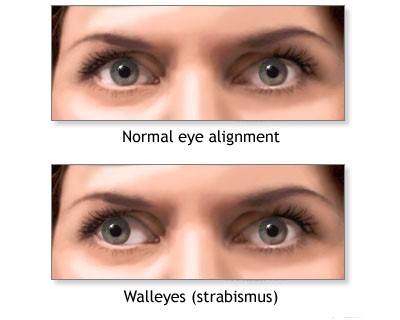
Strabismus is a disorder in which the two eyes do not line up in the same direction, and therefore do not look at the same object at the same time. The condition is more commonly known as "crossed eyes."
People are very sensitive to other individuals' eye positions. By looking at another person's eye position, one can very effectively gauge where they are looking. People are also sensitive to eyes that are not looking in the same direction, which is referred to as crossed eyes (strabismus). Other more specific medical terms refer to eyes turned either outward or inward, or that are abnormally rotated. Any appearance of crossed eyes in young children should be immediately evaluated, as should recent onset of crossed eyes in an adult.
People are very sensitive to other individuals' eye positions. By looking at another person's eye position, one can very effectively gauge where they are looking. People are also sensitive to eyes that are not looking in the same direction, which is referred to as crossed eyes (strabismus). Other more specific medical terms refer to eyes turned either outward or inward, or that are abnormally rotated. Any appearance of crossed eyes in young children should be immediately evaluated, as should recent onset of crossed eyes in an adult.
Six different muscles surround each eye and work "as a team" so that both eyes can focus on the same object.
In someone with strabismus, these muscles do not work together. As a result, one eye looks at one object, while the other eye turns in a different direction and is focused on another object.
When this occurs, two different images are sent to the brain -- one from each eye. This confuses the brain. In children, the brain may learn to ignore the image from the weaker eye.
If the strabismus is not treated, the eye that the brain ignores will never see well. This loss of vision is called amblyopia. Another name for amblyopia is "lazy eye." Sometimes amblyopia is present first, and it causes strabismus.
In most children with strabismus, the cause is unknown. In more than half of these cases, the problem is present at or shortly after birth. This is called congenital strabismus.
Most of the time, the problem has to do with muscle control, and not with muscle strength.
Other disorders associated with strabismus in children include:
A family history of strabismus is a risk factor. Farsightedness may be a contributing factor, especially in children. Any other disease that causes vision loss may also cause strabismus.
The first step in treating strabismus in children is to prescribe glasses, if needed.
Amblyopia or lazy eye must be treated first. A patch is placed over the better eye. This forces the weaker eye to work harder.
Your child may not like wearing a patch or eyeglasses. A patch forces the child to see through the weaker eye at first. However, it is very important to use the patch or eyeglasses as directed.
If the eyes still do not move correctly, eye muscle surgery may be needed. Different muscles in the eye will be made stronger or weaker.
Eye muscle repair surgery does not fix the poor vision of a lazy eye. A child may have to wear glasses after surgery. In general, the younger a child is when the surgery is done, the better the result.
Adults with mild strabismus that comes and goes may do well with glasses and eye muscle exercises to help keep the eyes straight. More severe forms of adult strabismus will need surgery to straighten the eyes. If strabismus has occurred because of vision loss, the vision loss will need to be corrected before strabismus surgery can be successful.
After surgery, the eyes may look straight but vision problems can remain.
The child may still have reading problems in school, and for adults driving may be more difficult. Vision may affect the ability to play sports.
With early diagnosis and treatment, the problem can usually be corrected. Delayed treatment may lead to permanent vision loss in one eye. About one-third of children with strabismus will develop amblyopia.
Because many children will get strabismus or amblyopia again, they need to be monitored closely.
When to Contact a Medical Professional
Strabismus requires prompt medical evaluation. Call for an appointment with your health care provider or eye doctor if your child: