You might not be Atlas, but your shoulders still carry a lot of weight. If it weren't for them, you wouldn't be able to pitch a game-winning home run, shovel snow off your front walk, or even comb your hair.
The shoulders' ball-and-socket design gives you great range of motion, but at the expense of stability. The shoulder socket is shaped like a golf tee, fairly flat on top, so the ball of the upper arm bone can easily slip out of it. That instability is why the shoulder joint gets dislocated more often than any other joint in the body.
When you lift weights every day or pitch every weekend, you can put a lot of wear and tear on your shoulder muscles, tendons, and joints. This is especially true if your form or technique is incorrect. Repetitive stress can lead to tears and other injuries, which can take you off the playing field and leave you in serious pain.
Here's a guide to the most common shoulder injuries -- how to spot them, and what to do about them.
What it is: Your rotator cuff is the set of four muscles that sits around the ball of the shoulder joint and allows the shoulder to move.
How it can get injured: Sports that involve lifting your hands over your head -- like pitching in baseball, swimming the freestyle or butterfly stroke, serving in tennis, and weight lifting -- can cause the top part of the shoulder blade to pinch the rotator cuff muscles. This is called shoulder impingement.
Repetitive motion in sports can also overload the tendons of the rotator cuff. Those tendons can eventually swell and get inflamed -- a condition called tendinitis. If you ignore the pain and keep swinging that golf club or tennis racket, the tendon that connects the rotator cuff muscles to the ball part of the joint can eventually tear.
What you'll feel: Pain is the main symptom of a rotator cuff injury. The pain gets worse when you raise your arm, and you might hear a click or popping sound. Eventually, the shoulder will hurt even when you're not moving it. A rotator cuff injury can limit your shoulder movement and reduce your strength.
How it's treated: Your doctor may suggest that you rest your shoulder for a few days, then begin rotator cuff stretching and mobility exercises. Avoid lifting anything above shoulder level until the injury heals. An anti-inflammatory medication or corticosteroid injection may help bring down swelling and reduce pain.
If the pain and weakness do not improve, you might need more formal physical therapy or surgery. The type of surgery done depends on the size, type, and location of the tear. It can take several weeks or even months for a rotator cuff injury to heal.
How to prevent it: Exercise your rotator cuff muscles to keep them strong and improve your range of motion. Be careful when you play sports like golf and tennis that use the same repetitive motions. Switch up your game once in a while. And stop whenever you feel pain.
AC Joint Injury
What it is: The AC (acromioclavicular) joint is located where the uppermost part of your shoulder blade -- a structure called the acromion -- meets your collarbone. When ligaments connecting the acromion and collarbone get torn, you've got a separated shoulder.
How it can get injured: Getting hit hard in the shoulder or falling on an outstretched hand can cause a separated shoulder.
What you'll feel: Pain in your shoulder. You might also see a bump on top of the shoulder where it's separated.
How it's treated: You will need to see your doctor if you suspect you have an AC joint injury. You will likely need to wear a sling to keep your shoulder still. Ice the area for about 20-30 minutes every couple of hours to reduce swelling. Take acetaminophen or a nonsteroidal anti-inflammatory drug like ibuprofen to help with the pain.
How to prevent it: Do range-of-motion and strengthening exercises. Gradually increase the weight and number of reps to strengthen your shoulder.
What it is: A dislocated shoulder happens when the top of the upper arm bone (the ball) slips out of its socket. The ball can slip forward, backward, or downward. Before you fully dislocate it, the shoulder might feel like it's starting to go out of place. That's called instability. When the shoulder slips only partway out of the socket, it's a subluxation.
How it can get injured: A strong hit to your shoulder on the football field or ice hockey rink can pop the ball out of its socket. You can also get a dislocated shoulder if you rotate your shoulder joint too far, like when you're serving in volleyball.
What you'll feel: You can feel when your shoulder pops out of place. The pop will be followed by intense pain. You might also have swelling, bruising, and weakness in the arm.
How it's treated: Sometimes, medical personnel can pull a dislocated shoulder back into place, but don't let anyone work on your shoulder unless you're sure he or she is experienced with the procedure. Otherwise, you could end up with an even worse injury. Instead see a health care provider who will give you a sedative or pain medicine before sliding your upper arm bone gently back into its socket. You'll have to keep the shoulder still for a few weeks afterward in a sling.
If the shoulder is being stubborn and it won't go back in place, you may need surgery to relocate the joint. Surgery can also repair torn ligaments or tendons in your shoulder.
How to prevent it: Check with your doctor to see when and how much you can use your shoulder. Once you've fully healed, he may suggest start exercising your shoulder to keep it flexible. Slowly add in weights and resistance bands to increase shoulder strength if OK with your doctor or physical therapist. If your shoulder has been dislocated before, ease off on the sports until it heals. That can take a few weeks. Anyone who's had a dislocation once has a good chance of it happening again. When you do start playing contact sports again, wear shoulder pads or other protective gear.
Elbow pain can be caused by many problems. A common cause in adults is tendinitis. This is inflammation and injury to the tendons, which are soft tissues that attach muscle to bone.
People who play racquet sports are most likely to injure the tendons on the outside of the elbow. This condition is commonly called tennis elbow. Golfers are more likely to injure the tendons on the inside of the elbow.
Other common causes of elbow tendinitis are gardening, playing baseball, using a screwdriver, or overusing your wrist and arm.
Young children commonly develop "nursemaid's elbow," usually when someone is pulling on their straightened arm. The bones are stretched apart momentarily and a ligament slips in between. It becomes trapped when the bones try to snap back into place. Children will usually quietly refuse to use the arm, but often cry out when they try to bend or straighten the elbow. This condition is also called an elbow subluxation (a partial dislocation).
Other common causes of elbow pain are:
· Bursitis -- inflammation of a fluid-filled cushion beneath the skin
· Arthritis -- narrowing of the joint space and loss of cartilage in the elbow
Your health care provider will examine you and carefully check your elbow. You will be asked questions about your medical history and symptoms such as:
· Are both elbows affected?
· Does the pain shift from the elbow to other joints?
· Is the pain over the outside bony prominence of the elbow?
· Did the pain begin suddenly and severely?
· Did the pain begin slowly and mildly and then get worse?
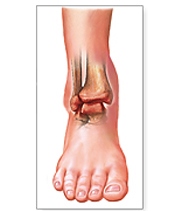
Лодыжки и нижние суставные поверхности большеберцовой и малоберцовой костей образуют голеностопный сустав. Связки, соединяющие кости друг с другом, стабилизируют и поддерживают сустав. Мышцы и сухожилия участвуют в его движении.
К наиболее распространенным травмам лодыжки относятся растяжения и переломы. Растяжение – это повреждение связок. Для полного восстановления после такой травмы необходимо от нескольких недель до нескольких месяцев. Перелом – это нарушение целостности кости. Также могут быть травмированы и другие части лодыжки, такие как сухожилия, которые соединяют мышцы к костям, и хрящи, которые амортизируют ваши суставы. Растяжение связок голеностопного сустава и переломы являются частыми спортивными травмами.
Травма$nbsp;акромиоклавикулярного сустава происходит в результате падения на плечо.
При этом возможно три типа травмы:
Тип 1 – растяжение сустава
Тип 2 – частичное смещение (дислокация) сустава
Тип 3 – полное смещение сустава.
Лечение. В большинстве случаев травмы акромиоклавикулярного сустава не требуют хирургического вмешательства. Обычно назначают обезболивающие и противовоспалительные средства местного и общего применения. Лечебная физкультура позволяет восстановить мышечную активность и упругость связок.
Хирургическое вмешательство требуется если функциональные нарушения сохраняются более 3 – 6 месяцев после травмы.
У вас может появиться неспособность нормально двигать локтем после травмы из-за боли или опухоли. Боль может появляться, когда вы задействуете конечность или сустав. Из-за опухоли у вас могут быть ограниченные пределы перемещения.
Если сустав нестабилен или вы не можете нормально работать рукой, то возможно, травмированы поддерживающие связки и сухожилия, либо переломана кость. При попытке подвигать суставом может возникнуть сильная боль. Ребенок будет ограждать руку или отказываться ее использовать, если она сильно травмирована.
Если движение травмированного локтя причиняет боль, ограждайте его. Возможно, потребуется шинаили поддерживающая повязка.
Полная неспособность согнуть или подвигать сустав может быть вызвана повреждением нерва, разрывом мышцы или разрывом сухожилия. Потеря функции, не обусловленная болью, может указывать на повреждение мышц, сухожилий, связок или нервов и требует медицинской помощи.
Причиной ограничения подвижности сустава также может быть остеоартрит, локтевой бурсит, ревматоидный артрит, подагра или волчанка.
Сильное ограничение подвижности сустава происходит, когда в шарнире локтевого что-то застревает и мешает полностью выпрямить или согнуть руку. Причиной этого состояния может быть:
Свободный обломок кости (при переломе или остеоартрите), хрящ или инородное тело в суставе(суставная мышь). Отломок плечевой кости либо локтевой или лучевой кости может застрять в локтевом суставе после травмы или от перегрузки локтя, может перестать кровоснабжаться и отколоться (рассекающий остеохондрит).
Есть повод беспокоиться, если ребенок младшего возраста тщательно защищает поврежденный локоть или отказывается использовать данную руку. У ребенка может быть перелом, вывих лучевой кости или растяжение связок вокруг локтя (локоть няни). Это обычно происходит, когда ребенка дергают, поднимают или тянут за одну руку. Если вы думаете, что травма вашего ребенка могла быть вызвана плохим обращением, обратитесь к своему врачу.



 Любите бегать? Регулярно меняйте несколько пар обуви и вы убережете себя от травм.